
Rev. Dr. A. W. Anthony Mays
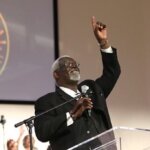
Rev. Dr. A.W. Anthony Mays was born to Charles William Mays Sr. and Dorothy (Clark) Mays in 1949 and raised in Round Rock. He was born at the historic Dickey Clinic in Taylor, then the only clinic in Williamson County that was owned and operated by an African American doctor.
Anthony was baptized at age 7 and became a member of the Sweet Home Baptist Church. After the death of their mother in 1957, he and his brother Charles Jr. were brought up by their maternal grandmother Ardie Mae Clark.
Anthony attended the segregated Hope Well Colored School from first – 9th grades. He also competed in oratorical contests sponsored by the Negro League and held each year at Prairieview A&M.
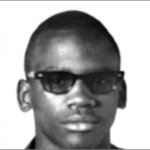
In 1964 Anthony transferred to the previously segregated Round Rock High School, becoming its first African American student. The school district had approved free choice that year, which gave Black students the option of transferring to white schools, but did not have any takers. As Anthony tells it, he decided to transfer when his older cousin remarked that it was a shame none of the Hope Well students were going and he impulsively responded “I’m going to go.”
For the next two years Anthony was the only African American student at Round Rock High School. He graduated in the top 10% of his class, lettered in football, was captain of the track team, and was elected to student council.
He remembers being nervous because he didn’t know anyone there and didn’t know if he would be accepted, but with his calm and friendly temperament he soon made friends, particularly through athletics. He later reflected that the transition was smooth and undramatic.
Because of his opportunities at RRHS he was able to earn enough credits to enroll at UT Austin. He graduated in 1971 with a major in English and a minor in history.
While at UT he was called to ministry and preached his first public sermon in Round Rock at Sweet Home Baptist Church on Easter Sunday in 1969. The next year (his senior year) he was called to become pastor there.
In 1973 he enrolled at the Southwestern Baptist Theological Seminary of Forth Worth but had to leave a year later for health reasons. He eventually returned and finished his Master of Divinity degree in 2019 at the age of 69.
Anthony didn’t wait for a degree to begin his career. He preached at Baptist churches in Wichita Falls and Tyler, then in 1986 he was called to Mount Sinai Missionary Baptist Church in Austin, where he still serves. He and his wife Fannie have five children, Mark, Meshawn, Michael, Dorothy, and Matthew, and now have 15 grandchildren and 5 great-grandchildren.
The Round Rock Independent School District
Few institutions have shaped the City of Round Rock as profoundly as the Round Rock Independent School District. Even before the district was formed, the community recognized that strong educational opportunities attracted families to the area. Many children and young adults boarded with Round Rock families to attend the Greenwood Masonic Institute, which opened in 1868 and was succeeded by the Round Rock Institute in 1883, and Trinity Lutheran College, which operated from 1906 to 1929.
The Round Rock Independent School District was established in 1913, the same year the city was reincorporated. The Round Rock Institute burned down that year, and the district was formed partly to fund a new school building. A three-story brick school, designed by architect Ollie J. Lorehn, opened in 1914 at the current site of C.D. Fulkes Middle School. The building included classrooms for all 10 grades, an auditorium, and art rooms but was demolished in 1962 after it became structurally unsound after blasting for the construction of Interstate 35.
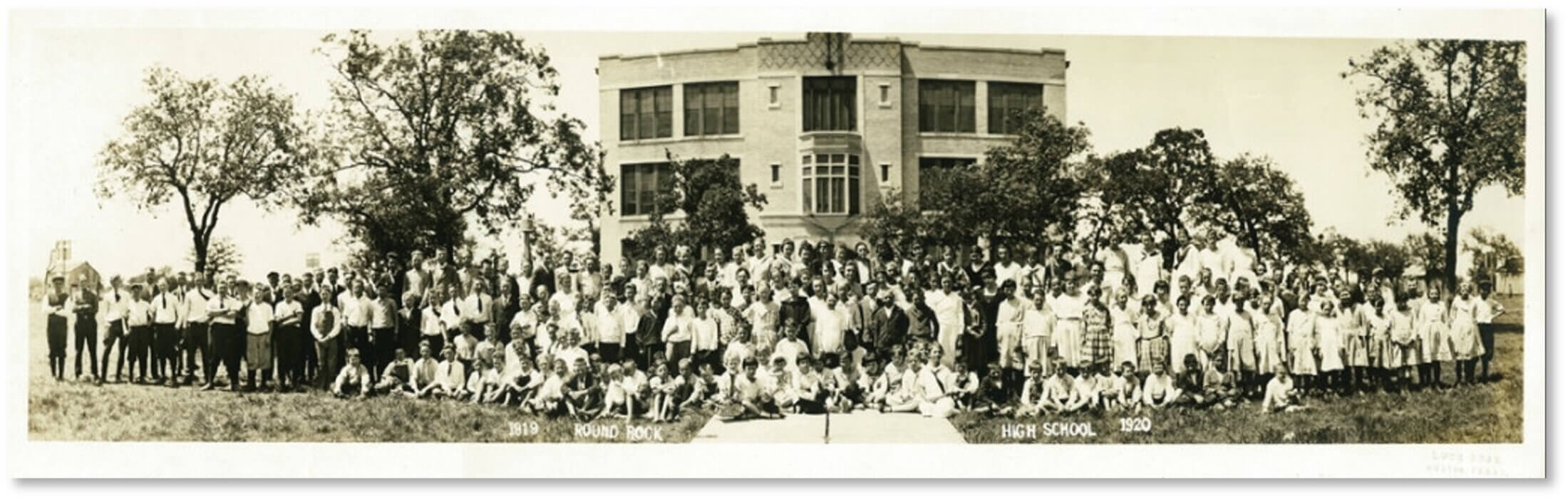
From its earliest days, the district ensured that every child had access to quality public education. Due to segregation laws at the time, Black students were initially taught in rented churches and community spaces until Hope Well Colored School was built in 1922 with assistance from the Rosenwald Fund. A separate Mexican School, located on the former Round Rock Institute site, was established in 1934 and operated until 1948. Hope Well Colored School remained in use until 1966, when it became one of the first districts in Central Texas to fully desegregate. The Hope Well building was later moved to the Round Rock High School campus, where it currently serves as a meeting facility.
For its first 60 years, RRISD was a small rural district with fewer than 1,000 students. Between 1939 and 1957, Principal and Superintendent O.F. Perry brought students to a central high school from around the district, making it feasible to offer advanced classes, sports, and extracurricular activities. A new high school wing was added in 1942, which later became C.D. Fulkes Middle School after the current high school opened on Lake Creek Drive in 1971.
From 1957 to 1979 Superintendent Noel Grisham oversaw a period of rapid expansion as families moved to communities north of Austin. The district boundaries grew to include these communities, ten new schools were built, and the student population grew from about 1,000 to 8,000. Since the 1970s, RRISD has remained one of Texas’s fastest-growing school districts and today includes 56 campuses serving more than 46,000 students.
Round Rock ISD has been central to community life throughout its history. During World War II, campuses hosted war bond drives and civil defense training. Today, the district’s family support team and social workers connect students and families with resources for counseling, food assistance, and health care, and assist students in foster care or experiencing homelessness.
Round Rock ISD’s commitment to academic excellence continues through award-winning programs in fine arts, robotics, athletics, and multicultural education. This long-standing dedication to quality education not only enriches lives but also contributes to economic development, since “great schools” continue to be a top reason cited by families and employers choosing to locate in Round Rock.
Marshal Samuel E. Loving (1868-1953)
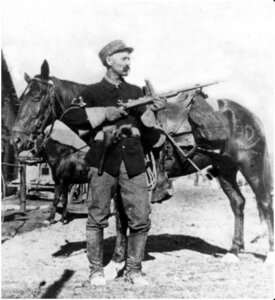
Samuel Edward Loving was Round Rock’s first City Marshal after it reincorporated in 1912. He was born in 1868 in Llano County to John and Elizabeth Jane Loving. Sam and his mother later moved to Williamson County’s Round Rock precinct, where Elizabeth eventually remarried.
Becoming City Marshal may have been a natural progression for Samuel. At age 10, he witnessed the 1878 gun battle between lawmen and the Sam Bass gang. In 1893, when he was 25, he was a passenger on a train that was held up by a gang of robbers, losing 60 cents that day. In 1898, he was one of three Round Rock men who served during the Spanish-American War. Samuel was a farrier for Company E, 1st Texas Cavalry Volunteers, and was shipped from Camp Mabry in Austin to Fort Sam Houston in San Antonio, but the war ended before they could be deployed to Cuba.
After his six-month adventure as a soldier, Loving returned to his mother and stepfather’s home. In December 1901, he married Ruth Meritt, a 19-year-old widow in Llano County, who died of a brief illness less than a month later. In 1906, he married Hattie Broadway in Round Rock and took in her 8-year-old son, Vander. Vander would later become the circus aerialist and female impersonator better known by the stage name Barbette. Sam and Hattie had Eugene, the first of their five children, in 1910. The chance to become marshal in 1913 may have been quite exciting for Loving, who at the time worked as a laborer in the Round Rock Broom Factory.
Loving’s years as Marshal appear to have been largely quiet. He worked on a string of burglaries in 1913, when W.M. Gault’s saloon was robbed the business and customers of more than $100 and the saloon-keeper’s gun. In February 1914, local merchant W.H. Lawson was shot and killed on the Brushy Creek bridge in Old Round Rock as he walked home with the day’s receipts in his pocket. Initially the marshal also served as streets commissioner, and Loving saw to the placement of Round Rock’s first two streetlights and first speed limit signs (12 mph).
After his term as Marshall ended, Loving was shown in the 1920 Census as being employed as an oil well foreman in Stephens County. By 1930 he was back in Round Rock living on Anderson Avenue and delivering newspapers. He was also an assistant scoutmaster for Round Rock’s boy scout troop and at some point served as chief of the Volunteer Fire Department. He ran again for Marshall but was defeated twice, losing to Luther Ramsey in 1931 and Tom McNeese in 1937
In 1940, Loving was a newspaper salesman with his youngest son Sam living at home. His stepson Vander had also returned home after spending much of the 1930s in France. Loving passed in 1953 at the age of 85 from heart disease. His death certificate lists his usual occupation at “Marshal,” and he is buried in Round Rock Cemetery.
The Flats Neighborhood
The Flats Neighborhood is a low-lying residential area east of Mays Street and south of Brushy Creek. The Flats has historically been a hub of activity and tight-knit multi-ethnic community whose resilience and ingenuity has contributed to Round Rock’s development for many generations.
The Flats was the first subdivision addition to New Round Rock. Washington Anderson sold 150 acres to the railroad, which laid out streets and blocks around its new train depot between Bagdad and Anderson Avenues. Anderson soon extended the railroad company’s street grid from Anderson Avenue north to Brushy Creek and began selling lots.
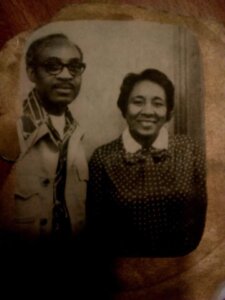
Until the 1930s, one block in the Flats at Sheppard and Austin Ave. was entirely occupied by a cotton yard, where cotton that had been processed and baled at the gins downtown was weighed, graded and stored before loading onto trains at the freight platform.
Many of the homes in the flats built in the early 1900s were built by Otto Sauls, who also lived in the neighborhood. When St. Paul’s AME church, the second oldest Black church in Round Rock, had to move out of the path of Interstate 35, it found a new home in the Flats on Sheppard Street. Another longtime resident was Joe Lee Johnson, the last principal of Hope Well Colored School and the first black teacher to integrate into RRISD. In addition to being an educator, Glee Coach, and mentor he and his wife Melownie owned several businesses in the Flats, including Cozy Corner (now the site of the new library) and The Café.
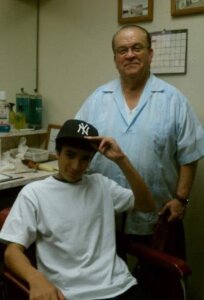
The neighborhood was close-knit because many residents did not have cars and did their work, shopping, and socializing within walking distance. Until the 1980s most residents worked and shopped “uptown” on Main Street, at Johnson’s Grocery, the Economy Drug Store and Rubio’s Grocery. The Flats has also been a setting for cultural activities, such as Fiesta Amistad’s Memorial Day events honoring Round Rock residents for their military service, that used to be held at Veterans Park.
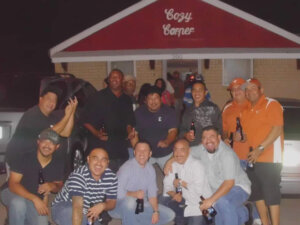
This area was also vulnerable to flooding until 10 dams were built west of Round Rock between 1956 and 1966. Even with these protections, several homes on Pecan Street were flooded during tropical storm Helene in 2010. As the neighborhood had done many decades earlier, residents helped their neighbors who lived closer to Brushy Creek, providing food, clearing debris, and giving financial and moral support. The city later purchased some of the creek frontage in the floodplain, which will become part of The Downtown Park.
Watch video of the presentation at the November 16, 2023 City Council Meeting (agenda item F.1)
Chris and Linda Perez
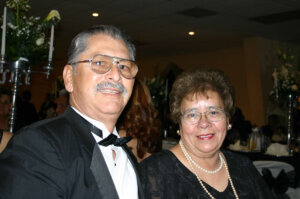 Known as the “Old Town Mayor and First Lady”, Chris and Linda Perez met when they were migrant farmers picking cherries and cotton in Oklahoma down through Texas. In the early ‘60s, back when Round Rock had a mere 2,000 population, the pair settled down, set up their homestead, and began to put down those deep Round Rock roots. In November of 1966, the two became the first Hispanic business owners when they opened the doors to their dual barber and beauty shop.
Mr. and Mrs. Perez considered the community as a “family” and treated It like one. When a client was too ill to come to the shop for a haircut, Chris was known to drive to the customer’s house to get the job done. It was this deep sense of family and community that drove the Perez’s to believe that the town and community were “growing up together”. They were so tight-knit that several small businesses in fact were established with the guidance of the Perez’s. This ranged from advice to even co-signers for loans!
Chris and Linda have been faithful members of St. Williams Catholic Church and through the church, Linda became a member of the oldest chapter of the Guadalupanas, from the Nuestra Senora de Guadalupe, Patroness of America. This is a religious association organized by Mexican American Catholic women to provide leadership in social concerns and to perform works of charity.
The Texas Baptist Children’s Home approached Chris and Linda to see if they would provide foster care to children when the Home did not have room for the number of children needing help. Over the years, they fostered twenty-three children.
Their remarkable contribution to the community did not stop there. Both Chris and Linda have promoted and helped run “Frontier Days”, “Fiesta El Amistad” and the “White Cane” society for the blind. Chris was a national speaker for the Williamson County Literacy Council. He toured the U.S. on the importance of having an education, especially since only attended the third grade, and never learned to read or write until he was well into his 50’s. Additionally, Chris was a founding member of El Amistad Club, committed to supporting high school graduates with continued education through scholarship and support to the community. Linda became a familiar face at the courthouse. She was a translator for both county and district courts. Linda was also a member of Ladies El Amistad. Chris also ran United Way from their shop for needy families of the community. With all of this, Chris found time to preside over the Lion’s Cub and maintain a membership of the chamber of commerce and national membership of United Way of Williamson County.
These contributions to the community and many others earned them the award of “Service to Mankind” from the city of Round Rock in 1979. The impact they have had on the development of Round Rock is incredible and has contributed to the “Family” of Old Town.
Old Town
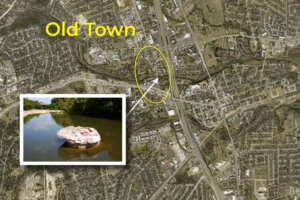 “Old Town” is Round Rock’s original commercial settlement that emerged after Texas joined the Union in 1845, thirty years before its “downtown” was founded. When Jacob Harrell claimed his headright in 1840 for military service in the Texas Revolution, he selected land at a low water crossing on the Military Road leading north from Austin. As two stagecoach routes opened on the Military Road and settlers streamed into Texas, Harrell sold parts of his property to businesses as well as farmers, and by the 1850 Census the area had a population of about 250. The settlement was originally called “Brushy” after the creek, but since another community was already using that name the postal service asked for a new one. In 1853 postmaster Thomas Oatts named the community after a round rock that marked the low water crossing, where he often fished with Harrell.
Transporting building materials by ox cart was expensive, so most structures were built according to folk tradition with wood felled and milled nearby, and stone quarried from the creek bed. Surviving buildings include several homes, one of which was also where Dr. Black saw patients, the Stagecoach Inn, the St. Charles Hotel, the post office and general store, and a livery. Greenwood Academy, the county’s first high school, shared a building with the Masonic lodge, roughly where GattiTown is now. At least one family built a house where their six children would stay during the school year, though most students boarded with local residents. Greenwood’s most famous alumnus was probably outlaw John Wesley Hardin, who graduated after attending for a single day.
The Military Road was also used by the great cattle drives that helped Texas recover after the Civil War.
In 1876 a railroad line was extended to within a mile of Round Rock, where the railroad company established a town around the depot. Businesses quickly relocated to take advantage of the depot and the area came to be known as “New Town,” while the original settlement became “Old Town.” Commercial activity in Old Town gradually faded until US highway 81 completely bypassed the Military Road in 1936.
Yet the lack of commercial attention helped to save many of Old Town’s historic buildings. In the 1950s a group of retired army officers bought and restored several of the old pre-railroad houses. The “Army Colony’s” enthusiasm encouraged the city to capitalize on its old west heritage with projects like creating the first Fronter Day in 1965 and renaming the old Military Road after the Chisholm Trail. Recent park projects also draw from the history of that original settlement, including the bronze cattle at Chisholm Crossing Park, restoration of the Stagecoach Inn, and Heritage Trail. We encourage all residents to visit Old Town and the landmark Round Rock.
Watch video of the presentation from the November 17, 2022 City Council Meeting (agenda item E.1).
John Wesley Wilbarger (1812-1892)
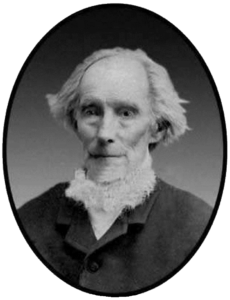 John Wesley Wilbarger is named a Round Rock Local Legend in recognition of the decades he spent collecting, verifying, and documenting stories of conflict between Indians and Texas settlers.
John Wesley Wilbarger and his wife Lucy moved from Kentucky to Texas in 1837 (just after Texas independence) to join his brother Josiah Pugh Wilbarger, who had settled in Stephen F. Austin’s Colony near Bastrop in the late 1820s. While on a surveying trip in 1833 Josiah had been scalped by Comanche Indians, but was rescued by Reuben Hornsby and lived for another 11 years. His brother’s experience sparked John Wesley Wilbarger’s lifelong interest in settler conflicts with Native Americans.
John Wesley became a farmer and Methodist Minister and amassed fairly extensive land holdings in Williamson County, although he doesn’t appear as a resident of the county until the 1870 census. In 1852 he bought 316 acres out of the Jacob Harrell survey in what is now Round Rock. There either Wilbarger (or possibly the previous owner) built a two-story stone structure now known as the Sansom House although it was most likely built as a livery or stagecoach stop. He built a stone house about a mile west of there, just south of a swimming hole on Brushy Creek known as Wilbarger Hole. A number of other landmarks were named for his brothers, including Wilbarger Creek, Wilbarger Bend Road and Wilbarger County.
Around 1870 Wilbarger began to methodically collect accounts of conflicts between settlers and Native Americans, first published in 1889 as Indian Depredations in Texas. As one might assume from the title, the book took the settlers’ side in these accounts with little sympathy for the Indians or consideration for their motives. Nevertheless, he documented and verified more than 250 separate incidents, and his 672-page collection is an important historical record of these conflicts. The book is considered a classic work of Texana and has been reprinted several times, most recently in 2015. The book also has thirty-four artfully illustrated woodcuts signed by T. J. Owen which have subsequently been attributed to William Sydney Porter, another notable Texan better known by the pseudonym O. Henry.
The Round Rock White Lime Company and the Walsh Family
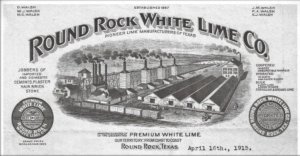 Billed as the “oldest and largest lime works in Texas”, the Round Rock White Lime Company was once the largest employer in Williamson County. The company’s founder, William Walsh, was born in Limerick, Ireland in 1837. His family left Ireland during the famine, and at age 14 William joined the British Navy. After several years he went to New York and joined the US Navy, serving on ironclad ships during the Civil War. After the war he was sent to Texas where federal troops had been assembled against Emperor Maximilian of Mexico. There he found work with the Army rebuilding the frontier forts of Texas. While working on Fort McKavett in 1868 he learned lime processing, in which limestone is heated in a kiln to make white lime, which is used in mortars, cements and plasters.
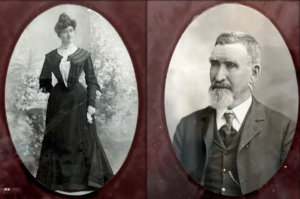
In 1874 he married Dora Koch, a German widow he’d met in Galveston, and adopted her young son. William and Dora would have 9 more children, 5 of whom lived to adulthood. In 1879 he established the Mount Bonnell Lime Works west of Austin. The plant provided lime and Portland cement for many Austin landmarks including St. Edwards University and the Texas Capitol building. Walsh Boat Landing on Lake Austin is named for him.
After discovering a superior quality of limestone in Round Rock, Walsh relocated his entire operation there in 1896. The plant also made fire brick, Portland cement, plaster, and wooden barrels to ship them in. His family followed seven years later, moving into a 2-story house on San Saba Street, which is now a historic landmark. In 1904 a barrel of the new Round Rock white lime was entered in the St. Louis World’s Fair, where it won a first-place medal. William Walsh became legendary as a founding father of the area and the proud owner of the Round Rock White Lime Co. The Round Rock Leader once noted that William Walsh was the last private businessman to hire more than 300 people in Round Rock until Michael Dell.
After William died in 1908 ownership passed to Dora and their sons, with youngest son Edward in charge of operations until 1949. Under his leadership the company hired many immigrants who had fled the Mexican Revolution between 1910 and 1920, establishing the first sizable Hispanic community in Round Rock. Edward was an entrepreneur and rancher, was elected to Round Rock’s first City Council, and was the first person in Williamson County to apply for a liquor license after Prohibition.
William’s oldest son became a local retailer, opening the WJ Walsh General Merchandise store at 121 E Main in the 1890s and The Fair at 117 E. Main in 1900. The Fair was a company store serving the White Lime Company workers. WJ Walsh built a home on West Bagdad Avenue in 1931, which was a historic landmark until it was remodeled in 2006.
The Round Rock White Lime Company remained a major employer until it closed in the 1980s. One of its quarries was redeveloped as the Round Rock West subdivision, and its excavation pits is now the pond in Round Rock West Park.
Watch video of the presentation from the November 4, 2021 City Council Meeting (click on agenda item F.1 to skip to the presentation)
Anna Palm (1808-1878)
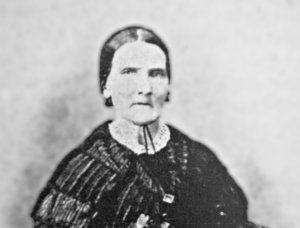 Residents and visitors to Round Rock will run across the name “Palm Valley” in a variety of places, but few folks may be aware of the origins of that expression. Palm Valley is named not for a grove of trees, but for a pioneer woman named Anna Palm. At the age of 40, Anna and her husband, Anders, and their six sons boarded a small sailing vessel in 1848 and left their home in Sweden for the New World.
After her husband died in 1853, Anna and her boys moved to an area about three miles east of the present-day downtown Round Rock. There the seven of them lived in a tent and their wagon for over a year before finally building a small log cabin. To survive, they cleared the land of thick brush and trees, planted crops, fished in Brushy Creek and hunted game for food.
Anna’s son, Henning, died in 1868. Since there was no pastor to comfort her, no church to support her, and no cemetery to receive the dead, Anna felt compelled to establish a common final resting place for her son and for fellow immigrants. Since her nephew, S.M. Swenson owned great parcels of land, she appealed to him to donate an acre. He was glad to comply, asking only “Where?” She replied, “Under the tallest oak tree.” That was the beginning of Palm Valley Lutheran Church Cemetery. His grave is clearly marked, along with Anna’s, whose remains were later buried next to her son.
Soon, Anna wrote home and encouraged family and friends to join her in Texas, with its fertile fields, inexpensive land, and abundance of food. Swedish immigrants poured into the area, populating Round Rock, Georgetown, Hutto, New Sweden, and Austin. Anna welcomed the newcomers and advised them on how to survive as pioneers. In recognition of Anna’s contribution to the development of this area, the region lovingly became known as Palm Valley. Soon these hardy settlers raised herds of cattle, planted corn and cotton, and opened businesses in Round Rock further establishing Round Rock’s place on the map.
Anna’s sons continued to live in the area, becoming successful farmers and ranchers, contributing to the health of the local economy. One son, William, lived in the stone house built by his wife’s father, T.J. Caldwell. It still stands today in Teravista. Another one of her sons, Andrew, built a wood frame house in 1873, where he and his wife, Carolina Nelson, raised eight children. This is the “Palm House” which later was moved to Main Street, next to the public library. Anna lived with them until her death in 1878 at the age of 70. Several years later Andrew built a large two-story house. It can be seen today at the entrance of Old Settler’s Park. A major portion of the Palm estate was bequeathed to Palm Valley Lutheran Church by Anna’s grandchildren. Today that land comprises the immense and highly popular Old Settler’s Park.
Anna Palm helped to raise Round Rock from its infancy to become a strong, prosperous, and respectable town. The inspiring story of this community’s pioneer woman deserves to be known by all today, so that whenever we see the name “Palm Valley,” we will be reminded of this remarkable woman on whose shoulders we stand today.
Hope Well Colored School
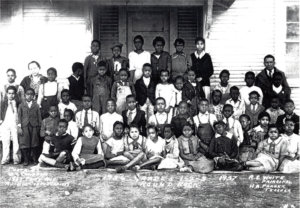 The July 5, 1921 minutes of the Round Rock Independent School District Board of Trustees Minutes state [quote:] “The committee on the Negro school building made the report that the Rosenwald Fund would pay $1,200.00 on a new building…” thus establishing a permanent place for Round Rock ISD’s segregated students to learn. African-American students received an education as part of Round Rock ISD as early as 1914, but Jim Crow laws regulated separate school facilities for white and black students. On May 8, 1922, C.E. Johnson was hired as principal for the school at a salary of $80 per month, for six-months. M.A. Starks was elected teacher in the school at a salary of $55.00 per month for six months of service. The school officially opened for students during the fall of 1922 and was located at the southwest corner of McNeil Road and what is now IH-35.
In its early days, one principal and one teacher would divide the teaching duties for students who represented nine different grades. As attendance increased, grades one through ten were clustered into four groups for instruction: 1-3, 4-6 and two classes for 7-10th grades. In 1928, the school year was lengthened from five to seven months. In 1936, an additional 2.4 acres of land were purchased to accommodate growth in the student population. The next three decades saw many improvements for the original Hope Well. The old tenant house on the school grounds was repaired and leased to the school principal, a new wing with additional class space and a cafeteria was added in 1950, and an annex southeast of the building opened in 1964.
In 1950 Joe Lee Johnson was hired as the school’s principal. He would remain in that role through desegregation. Johnson was recognized as a Round Rock Local Legend in 1991.
After the passage of Civil Rights Act in 1964, Hope Well School was renamed Southside Elementary School and served as Round Rock ISD’s third grade campus beginning with the 1966-67 school year. It later became a transportation center for the District. The building sat vacant for many years until a group of former Hope Well students and community groups urged the District to move and preserve the structure.
In October 1997, the original Hope Well building was moved to the grounds of the Round Rock ISD administrative offices at 1311 Round Rock Avenue. After extensive repairs and renovations, dedication ceremony was held on Saturday, February 24, 2001. Now referred to as “Old Hopewell,” the building is currently utilized as a District meeting space.
Through the life of the school, the building served as a center for community events, benefit dinners, musicals and commencement ceremonies which brought families together to raise money, enjoy entertainment and celebrate their many successes.
The award was accepted by Debbie Juhlke (Chair of the committee that preserved the old school building) and alumni of Hope Well Colored School and Hope Well High School: Patsy Anderson, Wilbur McConico, Harry Mercer, Jessie Mercer-Carson, Ella Sauls Morrison, and Ed Hardin.
Watch video of the presentation from the November 12, 2020 City Council Meeting (click on agenda item E.1 to skip to the presentation)
Charlie Culpepper
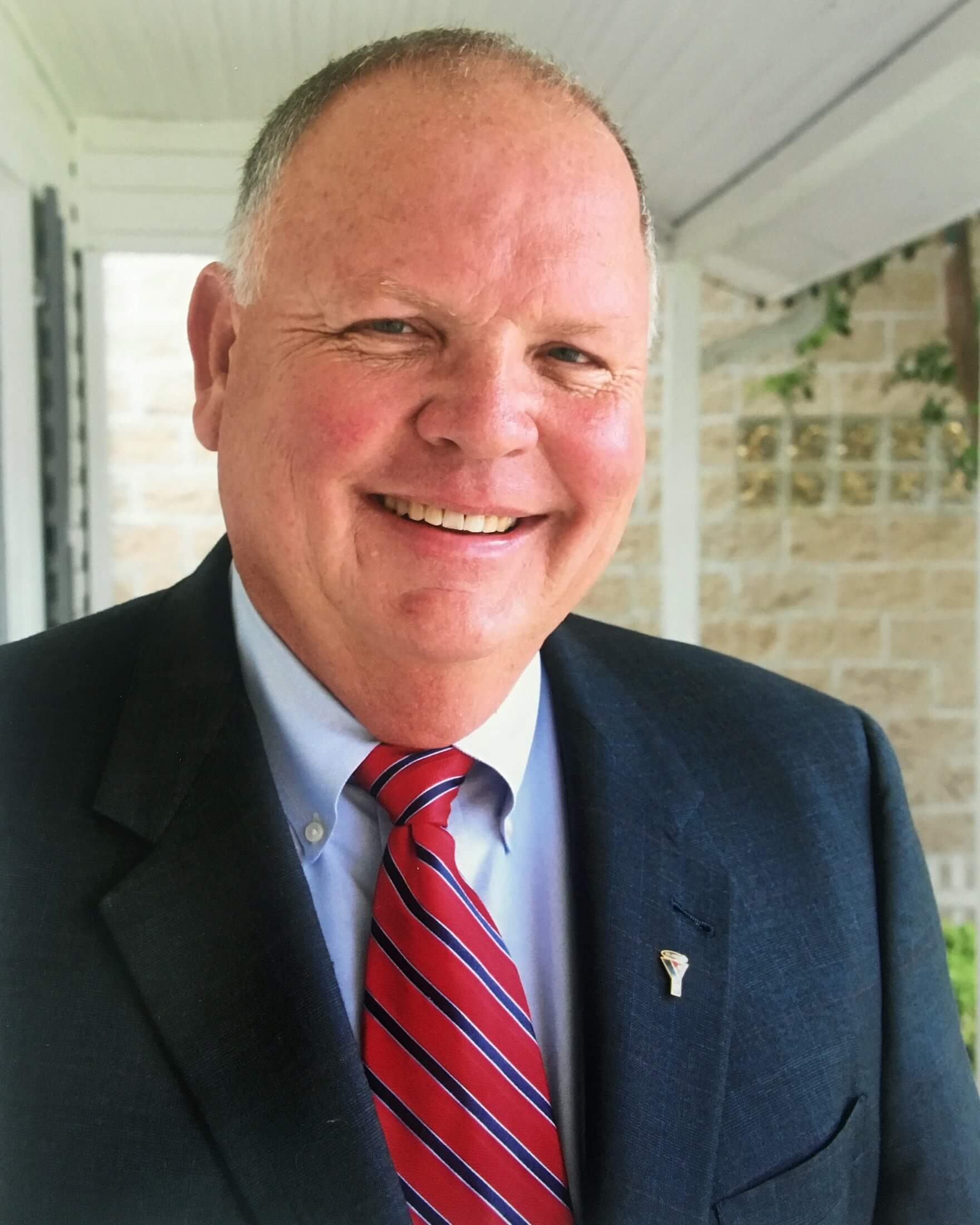 Charlie has served the city of Round Rock, the state, and its residents for over 43 years. His remarkable leadership, vision, and impact have left a remarkable legacy of achievements and an indelible mark on this community.
Charlie moved to Round Rock in 1977 with his wife Kathy after graduating from the University of Texas and serving in the Navy Reserves. At that time Round Rock had a population of 5,000 one traffic light, and one 2A high school.
He was elected to the City Council in 1989 and then Mayor in 1993. As Mayor Pro-Tem and Mayor he helped the Legislature work out details of enabling legislation to allow the sales tax arrangement that clinched Round Rock as the new headquarters for Dell Computers. Today Dell is the city’s largest generator of sales tax revenue while bringing over 12,000 jobs to the area.
In 1995 he negotiated a partnership agreement to build Mickie Kresbach swimming pool on land owned by the school district.
In 1996 Reid Ryan contacted Charlie about bringing minor league baseball to Central Texas. Knowing that voters would not support building the stadium with property tax funds, Charlie suggested incorporating a conference center to the stadium, allowing both to be built with hotel occupancy taxes instead. Voters approved the measure by 74%. The first Pitch at Dell Diamond was thrown in 2000 and that year the Round Rock Express set an attendance record on 660,110.
After leaving office, Charlie has served on 15 different boards or community development committees that have served Round Rock. During this tenure, the population has exploded tenfold, Round Rock has become home to 20 major employers, and has become an integral center to the success of the Texas Triangle of DFW, Houston, and San Antonio.
George White
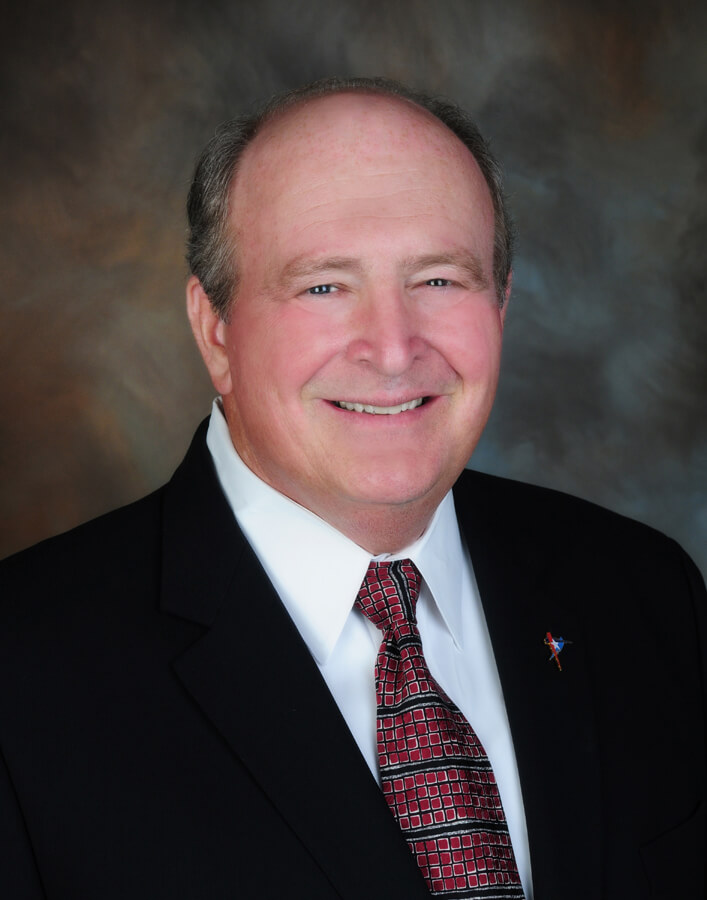 For over two decades, George White has demonstrated superior leadership and selfless dedication to many organizations that have greatly improved our Round Rock community.
George and his family moved here in 1998 for a position at Abbott Laboratories, where he rose to become Director of Operations for the Austin Area. Before this he received an MBA from the University of North Carolina and served as a US Army officer in Vietnam, where he received the Bronze Star.
While serving on the Board of Directors of the YMCA of Greater Williamson County, George became the voice of the Y’s leadership and served as unpaid interim CEO for six months while spearheading the nationwide search for a permanent CEO. He received the Y’s highest award when he was named to its Triangle of Honor.
George’s dedication to our military continued as Commander of the Round Rock Veterans of Foreign Wars Post 9078. He was named an All-State and All-American commander for 2010-2011. He serves as committee chairman of the David Hood endowment at the Greater Round Rock Community Foundation, whose mission is to support veterans and animal welfare.
In 2016, Congressman John Carter awarded him the Congressional Veterans Commendation Award for his unparalleled dedication and service.
George served on the Board of Directors for St. David’s Round Rock Medical Center for ten years including five as its chairman. He has been the Secretary of the Rural Capital Workforce Development Board, served as President of the Round Rock Noon Rotary Club and as a member of the Round Rock Police/Citizen Review Board. As chairman of the Brushy Creek Regional Utility Authority, he secured a long tern water source for Round Rock. He is a member of the Round Rock Chamber of Commerce and was named Citizen of the Year in 2005. George served on the City Council of Round Rock for eight years, the last two as Mayor Pro-Tern.
George and his wife Sally have been married for over fifty years. They have two children and seven grandchildren.
Juanita Jewel Shanks Craft
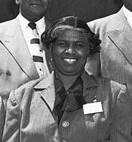 Juanita was born in Round Rock in 1902 to David and Eliza Shanks, both teachers in the local segregated schools. After her mother died of tuberculosis in 1918, Juanita finished high school at Austin’s Anderson High School while her father moved to Columbus for a principalship. She attended Prairie View State Normal and Industrial College, then returned to Austin for a teaching certificate from Samuel Huston College (now Huston-Tillotson University). By 1925 she had moved to Dallas, where she met and married Johnny Edward Craft in 1937 .
Her activism began she joined the NAACP (National Association for the Advancement of Colored People) in 1935, becoming its membership chairman, and later field organizer. Over 11 years she and Lulu Belle White of Houston traveled the state organizing 182 branches of the Texas NAACP and fundraising for litigation. Supreme court Justice Thurgood Marshall once observed that “what the NCAAP accomplished in Texas could not have transpired without her.”
Her work as Youth Council Advisor became a prototype for other NAACP youth groups throughout the country. She led the youth group picketing lunch counters, restaurants, theaters, public transportation, and the State Fair of Texas to protest segregation and discriminatory admission policies. Following the Brown v. Board of Education decision in 1954 she worked to integrate the Dallas Independent School District, North Texas State College, and the University of Texas Law School.
Her service has been recognized with many awards, including the Eleanor Roosevelt Humanitarian Award in 1984. In 1969 she received Dallas’ highest civic award for helping end fraudulent recruiting by Dallas trade schools. The Dallas Parks Department dedicated the Craft Recreation Center to celebrate her 72nd birthday in 1974.
She was elected to the Dallas City Council in 1975, championing measures to reduce drug and alcohol abuse, obtain fair housing, and strengthen code enforcement and historic preservation. After her death in 1985 her foundation donated her home to the Dallas Parks Department to become the Juanita Craft Civil Rights House Museum. She had no children but is quoted as saying “I had no children, so I adopted the world.”
St. Paul A.M.E. Church
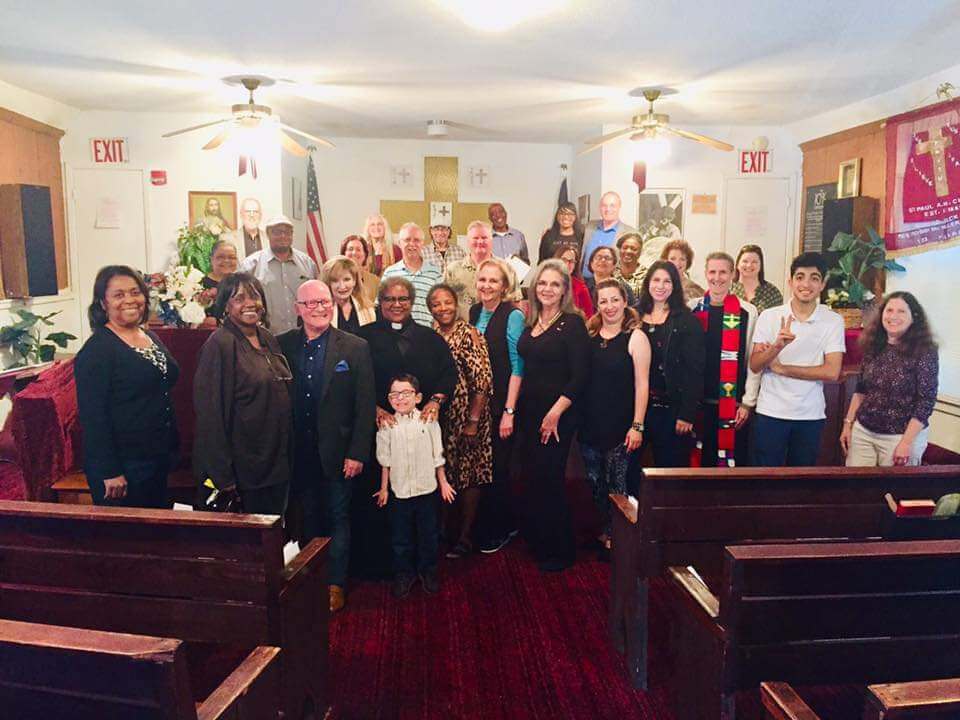 St. Paul African Methodist Episcopal Church was founded in 1885 as the first AME church* in Round Rock and the second in Williamson County. It was operated and attended by residents of Round Rock and surrounding communities.
The church was founded by the Sauls, Mays, Dixon, Washington, Wheeler, Freeman and Earl families. The original location of the church was just south of the original Old Settlers Park, which at the time was located at the southwest corner of RM 620 and Interstate 35, where Sprouts and McDonald’s are currently located. The original church was constructed of wood from an old barn donated by a local farmer.
When Interstate 35 was built the church had to relocate to its present location on North Sheppard Street. The Sauls brothers secured a $500 loan with Farmers State Bank to purchase the land from a sister to build the new church, and the new building was completed in June 1958. The church members were able to re-use some of the original church’s lumber, the windows, lightning rods, pews, altar, pulpit and piano in the new building. A large iron bell was stolen by local teenagers during the move, so it was not re-installed in the new steeple.
The congregation of St. Paul A.M.E. has served the Round Rock community and dealt with adversity and obstacles throughout the 135 years it has existed. St. Paul has had a number of notable ministers, including Reverend Mrs. Johnnie Mae Fulton from 1940-1965, who was the one and only female ordained minister in Central Texas at the time.
The church has regularly scheduled Sunday services, prayer services and opens its doors for community meetings and prayer vigils. St. Paul A.M.E. welcomes everyone and holds true to their mission to “provide spiritual and religious teachings and fellowship to the community and all who enter”.
*Note: Text has been clarified to indicate that St. Paul was the first AME church in Round Rock, not the first African-American church in Round Rock. Good Hope Baptist Church was founded in Round Rock by African-Americans in 1874. We apologize for the error.
Watch video of the presentation from the November 14, 2019 City Council Meeting (click on agenda item E.3 to skip to the presentation)
Faye Johnson
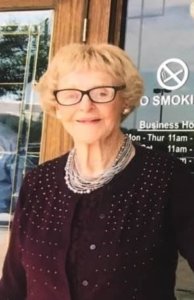 Dorothy Faye Johnson is a legend in the growth of the city and her servant leadership brought honor and distinction to the City of Round Rock. Faye is mother to four amazing children and was born and raised in Alabama where she met her future husband Charles at a skating rink her mother operated, just before he became a WWII sharpshooter. They settled in Round Rock in 1956 and quickly became part of the community. Charles ran the Tap and Texaco downtown for decades and was Round Rock’s first Planning and Zoning Commission Chair. The Tap and Texaco was a “men only” bar for beer, shuffleboard and washers, until it was destroyed in an explosion in 1984.
Faye was a social worker and attendance aide for RRISD for 39 years and her service was not limited to her day job. Faye was one of the many credited with the establishment of the library by beginning a home demonstration club and manning a book mobile on summer afternoons. She felt the path to social equality lie through education and led by example, earning her Associate’s degree at the age of 63. She supported youth interest in political science by encouraging and assisting students to attend the Texas Girls and Boys States, a youth leadership function of the American Legion. Faye was a champion for women and veterans and supported the Agape Foundation and the American Legion Auxiliary.
Faye loved Round Rock. She would often work to clean up Brushy Creek and campaigned to protect native species such as the Brushy Creek Turtles and the McNeil overpass bat colonies. Her efforts in the growth of Round Rock helped promote economic development, redevelopment, growth and tourism downtown. She was also a longtime member of the Williamson County Mental Health Board and was the Chairman of the Housing Authority when the first public housing was constructed. Faye was a member of Round Rock First Baptist Church from 1956 until her death in January 2019.
The Sauls Family
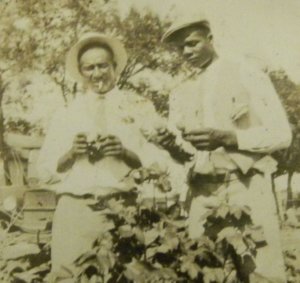
The Sauls family’s influence is woven into the history of Round Rock and can be seen in the land, economy and buildings that make up Round Rock today. Wade Sauls Sr. was born in 1879 to former slave parents. He was overseer of the Palm Farm for 36 years and also owned his own farmland in areas northeast and southwest of Round Rock where he raised cattle, hogs, horses and mules. Near one of his farms he built the low-water crossing on Hairy Man Road in 1911, which was the only crossing until Creek Bend Boulevard opened in 2015. Wade Sr. was known as “the Cotton King” because he was the only local farmer who could yield a bushel of cotton per acre.
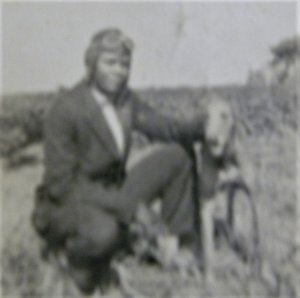
Wade and Louisa Sauls had 15 children. Their son Wade Sauls Jr. had a farm south of town that is now the site of the Joe Lee Johnson STEM school. Their son Ollie farmed areas northeast and southeast of Round Rock, growing cotton and raising cattle and hogs. Another son, Otto “Winzell” loved airplanes. In the 1930s he attended Paul Quinn College and then Georgetown Flying School which he was made to quit because of race. He also attended the American School of Aviation, but could not afford to complete his studies. Otto was drafted into the Army as a Tech 4 and served in the Pacific during WWII. After returning he became a carpenter and built homes in Round Rock, Brenham, Georgetown and Fredericksburg. In his later years he became blind but other builders still sought him out for advice.
The Sauls family has a long history of service to the community. Otto and several of his brothers, nephews and granddaughters served in the military during WWII, Korea, Vietnam and the Gulf War. Wade’s great-grandson Ollie Leslie Sauls Jr. was the first Round Rock resident killed in action in Vietnam. Otto’s daughter Ella Sauls Morrison was a nurse for over 50 years and currently serves in many community organizations including as Historian of the Heart of Round Rock Neighborhood Association. The Sauls family was instrumental in establishing St. Paul African Methodist Episcopal Church in 1885, now the second-oldest church in Round Rock. In 1958 Otto assisted its relocation and rebuilding when it was moved to make way for IH-35. Other family members have served as stewards, trustees and missionaries, and continue to do so today.
The Tonkawa Tribe
 The history of Round Rock, Texas as a community began long ago with a small band of Indians who became known as the Tonkawa. Native American groups are known to have camped along Brushy Creek and the San Gabriel River as far back as 9,000 B.C. The Tonkawa were known to be hunter-gatherers who were also resolute and accomplished warriors long before Europeans came on the scene. This small group of nomadic Indian bands unified as a tribe sometime in the 1840s after suffering staggering losses to disease brought on initially by the Spanish who were known to have close and frequent contact with the Tonkawa beginning in 1690. The Spanish established Mission San Xavier on the San Gabriel River for the Tonkawa in the mid 1700’s, establishing the first European “footprint” on US soil connected with the Tonkawa.
Our state fought for and won its independence with the help of the Tonkawa and other Indian tribes. During our dark days of division in the Civil War, the Tonkawa were there again to act as scouts for the Confederate Cavalry. Sadly, the era of good-will between the Tonkawa and Texas was challenged again and again by the inevitable clash of our two cultures so that by the 1840’s the State began the removal of the Tonkawa first to settlements near San Marcos until by 1859 they were removed from Texas to Oklahoma (then known as Indian Territory). We are all too familiar with the repetitive broken promises to our first citizens. It was an ugly and harsh time in our history and that of the American Indian. But, because of their perseverance, the Tonkawa survived their “Trail of Tears” and settled in a small town that bears their name in Northern Oklahoma. At present, there are 858 enrolled members of the tribe who founded our first community. As Round Rock citizens, we celebrate the American Indian who once roamed Central Texas but mostly the Tonkawa tribe who selected the Brushy Creek area as their homestead long ago. We hope to collectively live up to the meanings of the Tonkawa name, “Real people” and “They all stay together” as a community.
Watch video of the presentation from the October 25, 2018 City Council Meeting (click on agenda item E.1 to skip to the presentation)
T. Nyle Maxwell Jr.
 Nyle Maxwell and Nancy Kellerman married in 1985 and moved to Nancy’s hometown of Round Rock five years later. He and Nancy immediately set about making their community a great one to live in.
From 2002 through 2008, Nyle was honored to serve two terms as Mayor of Round Rock. He established office hours to allow residents to present concerns and ideas for improving the city and brought the Homeowners Association Presidents together in order to facilitate cooperation and collaboration between the neighborhoods in the City. He also forged a partnership between the Chamber and the City in the form of the Economic Development Committee.
While Nyle was in office there was concern that the City was becoming too dependent on sales tax from Dell Computer. Nyle focused on building destination retail, including IKEA and the Premium Outlet Mall, as a way to build sales taxes and keep property taxes low.
Nyle understood the value of higher education for our citizens. He lobbied heavily for the Round Rock higher education campus where Texas State University, A&M Health Science Services, and Austin Community College coordinate programs to greatly enhance the opportunities for Round Rock and surrounding area residents to get top-notch training locally. Medical services exploded when St. David’s, Seton and Scott and White all announced new facilities or major expansions in Round Rock. Nyle brought these organizations together to offer a collaborative approach to health care.
Nyle’s crowning achievement has been putting together the Round Rock Community Foundation, a collection of individual funds and resources given by local citizens to enhance and support the quality of life in Round Rock. Since its inception the Foundation has given out more than $6.2 million to local charities and community service organizations through grants, donations, and sponsorships.
Waymon Ferrell (1894-1980)
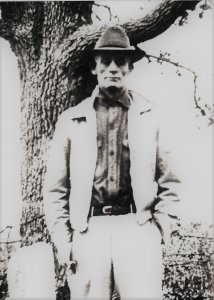 Waymon Ferrell had the distinction of serving every law enforcement role in Round Rock from the 1930’s through the early 1960’s: Night Watchman, County Constable, City Marshall, and Police Chief. He did all this despite losing both hands in separate accidents doing seasonal work at the Co-op cotton gin.
Waymon had already lost his left hand when he started his law enforcement career as a night watchman. Night watchmen were important to the town of Round Rock during the first half of the 20th century. They provided law enforcement while the elected City Marshal slept—responding to calls for service, checking to make sure businesses were locked and turning the streetlights on and off.
By 1932 he had become a Special Officer and frequently partnered with City Marshal Luther Ramsey and County Constable Fred Olson on liquor and drug cases. In 1933 the Round Rock Leader commended Ferrell for subduing a much larger drunk man without drawing a weapon. In 1934 he was credited with foiling a robbery by three men who had previously murdered two fruit sellers near San Antonio. During a busy week in 1945 when he was a County Constable, he helped Rangers and Highway Patrolmen arrest one man for assault and forgery, another for car theft, and four teenagers who confessed to killing a Marine in Oklahoma.
In 1955 Ferrell was appointed City Marshall, and became “Police Chief” when the City created a “Police Department”. Mr. Ferrell spent most of his adult life making Round Rock a safer place to live, do business, and raise a family. He is remembered as “a good Chief, strict, but got along with everybody, especially the young people.”
The Water Tower
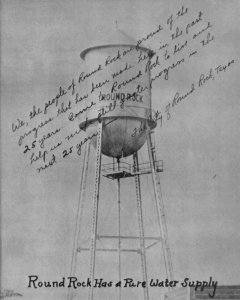 Before Round Rock had a central water system, residents got their water from the downtown mineral well, from cisterns, or purchased barrels of water that had been collected from nearby springs. In 1928 citizens soundly defeated a $36,000 waterworks bond, but only 7 years later the water tower was built. Certainly the Works Progress Administration funding had a lot to do with the change in opinion, but a fire downtown in 1929 probably also clarified the need for a ready, pressurized water system. A citywide sewer system soon followed in 1938, also made possible with WPA funding. The City’s pure water supply was a much-touted marketing point.
As the city and its water system grew, the downtown water tower became obsolete and was decommissioned. In 1999 Ruth Koughan donated funds to build a park under the water tower in memory of her husband William, whose CPA office had been at the foot of the tower.
In the mid-2000s the Parks Department installed holiday lights, making it visible for miles. Since the mid-2010s the tower has become a symbol of Round Rock, featured in Downtown branding and marketing, as well as almost every news or travel story about the city. It is an essential backdrop for social media photos, confirming its importance as a Round Rock icon.
Watch video of the presentation from the November 9, 2017 City Council Meeting (click on agenda item E.2 to skip to the presentation)
Vera and Joe Bloomer
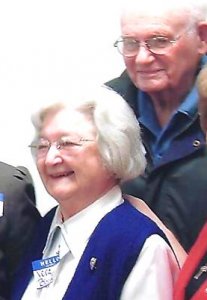 Vera and Joe Bloomer moved to Round Rock shortly before Joe retired with 30 years of military service. They were married after he returned from World War II as a POW. Soon after establishing roots here, Vera observed that so many families needed help satisfying basic needs (food, clothing, etc.) so began their journey to founding the Round Rock Area Serving Center in 1986. Vera solicited assistance from local churches and began helping families using the trunk of her car, their family garage, and even the basement of the American Legion as distribution sites. 48,491 people from 12,385 households were provided these essentials in 2015 alone. Joe and Vera were also among the founders of St. John Vianney Catholic Church.
Joe Bloomer was selected by El Amistad to be recognized as a veteran in 2017. He landed on Omaha Beach six days after D-day, was captured by the Germans and eventually liberated by Russian troops. Joe also served in a supply role in Vietnam after joining the Air Force. Among his awards are the Bronze Star and recognition as a POW. Joe was also a 4th degree member of the Knights of Columbus, toastmaster and the 15th Commander of the Capitol City Chapter of American ex-POWs. Vera passed away July 22, 2012 followed by Joe on July 16, 2016.
Jim Boles
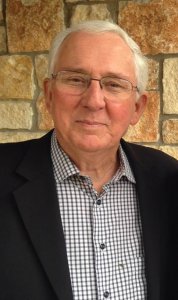 Jim and his wife, Monti, moved to Round Rock in the mid-seventies when its population was less than 6,000 and tax base was $13.7 million. Today Round Rock’s population is almost 110,000 with a tax base of $12.5 billion. Jim’s leadership during this time produced much of this positive growth.
Jim chaired the Round Rock Economic Development Committee for many years and started Momentum, a civic/city partnership that today oversees hundreds of thousands of dollars annually. He has helped recruit several Fortune 500 companies and others such as Toppan Photo Mask, Dell, Farmers Insurance, Emerson, Round Rock Express, and most recently Kalahari.
Jim is credited with initiating the drive that brought the first hospital to Round Rock, the St. David’s Round Rock Medical Center. Today Round Rock and the surrounding area have five hospitals, nearly all of which he played some role in locating here.
In the late 1970s, Jim and good friend Nancy Rabb helped start the Williamson County YMCA and it has grown today with an annual budget of over $26 million.
Jim is a founding member of the Round Rock Community Foundation, and has served as Chair and Vice-chair. The Foundation has made grants exceeding $5.8 million over the past thirteen years and its asset base has grown to over $16.9 million in charitable funds.
In the area of higher education, Jim was a founding member of the PAC that brought Austin Community College to Round Rock followed by Texas State University among others.
For many years the Williamson County Historical Commission has sought to establish a museum branch in Round Rock. When the historic William M. Warren/ Thomas C. Oats complex, 8 Chisholm Trial, became available in 2016, the Commission turned to Jim Boles for support and more importantly to negotiate the purchase of the buildings. Jim succeeded in acquiring the site and donated his fee to the Commission. Since then he has volunteered to serve as campaign co-chair to raise one million dollars to furnish the museum.
El Amistad of Round Rock
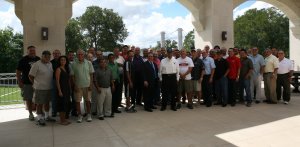 El Amistad is a diverse organization consisting of business owners, education professionals, and retirees all working together to provide scholarships for the future educational endeavors of our local youth.
The club was founded in 1968 to develop leadership in Round Rock’s Hispanic Community. Its members were encouraged to volunteer and become members of boards, task forces, and input groups. Currently its members serve in organizations including CASA advocates for children in the foster care system, United Way, PTA, Neighborhood Conference Committee Truancy Diversion, city commission and board volunteers, and as mentors and tutors of area youth.
The first Fiesta Amistad was Memorial Day weekend of 1969. Every Memorial Day since the club has honored Round Rock citizens individually for their military service.
Education has always been a priority for El Amistad. It awarded its first scholarship in 1970, and has sponsored tutorial programs, bilingual programs, and Literacy Council scholarships. Members representing the organization have volunteered at numerous other community and fundraising opportunities such as Kutz4Kidz, School supply drives, Stuff the Bus, Chalk Walk, and the Club’s golf tournament to raise funds for local area youth scholarships. In its 50 years the Club has awarded over one and one half million dollars in scholarships which were made possible due to the untiring efforts of the membership in the fundraising events.
Watch video of the presentation from the October 27, 2016 City Council Meeting (click on agenda item E.1 to skip to the presentation)
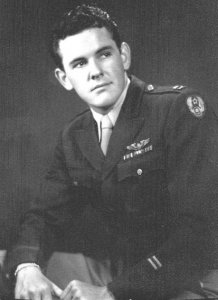 James W. Carothers (1923-2004)
Jim was hired as City Manager in 1968, when Round Rock’s population was approximately 2,000. Before coming to Round Rock, Jim had been a Lieutenant Colonel in the U.S. Air Force. He was a pilot in World War II and Korea, flew over 65 combat missions (including two on D-Day), and developed the signal beacon that pilots have on their parachutes for use in locating them if they have to eject from their aircraft.
As a small town Round Rock also had a small staff, so Jim was also responsible for the maintenance of the City swimming pool, a back-up driver for the city ambulance, and on call for the Police Department. Every morning, he went to the city sewage plant to check on the valves and set the switches, then came home, showered and went in to the office for his ‘regular’ City Manager duties. During his time as City Manager, the City passed its first zoning ordinance and entered a new phase of development after the Round Rock White Lime plant was closed.
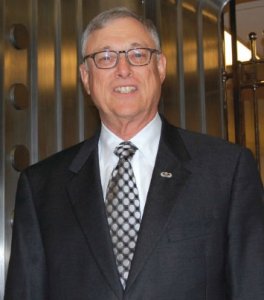 Jon E. Sloan
Jon Sloan is a Round Rock community force who provides his financial expertise, sound business judgement and leadership to a community that he respects and loves. His behind the scenes influence earned him the title “the man in the back of the room”. For 34 years he served as President of First Texas Bank, and has used his expertise in banking and finance to structure and promote bond packages for the City of Round Rock, RRISD, Austin Community College and Williamson County. He has been involved in almost every School Bond election in the last 30 years.
Under Sloan’s leadership, First Texas Bank became a generous contributor to community events and nonprofit efforts. He has been a leader or member of many, many nonprofit organizations, and is a relentless fundraiser for political, economic and social causes.
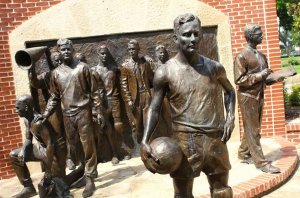 The Immortal Ten
On Jan. 22, 1927, a bus carrying the Baylor University basketball team to a game against the University of Texas was struck by a train at a crossing in Round Rock. Ten of the 22 people on the bus were killed, including half the basketball team. In its memorial announcement, the Waco Tribune-Herald dubbed the victims the Immortal Ten. The flag at the capitol was lowered to half-staff.
The Immortal Ten have come to represent the traditions and unifying spirit of the Baylor student body. Nationally, the accident prompted engineers and legislators to take their first serious look at road and vehicle safety issues. Texas’ first railroad overpass was built over the accident site in Round Rock. The City of Round Rock is in the process of making improvements to the overpass to commemorate the tragedy. In January, on the 90th anniversary of the accident, it will be dedicated as the Immortal Ten Bridge.
The Immortal Ten are: Jack Castellaw, Sam Dillow, Merle Dudley, Ivy Foster Jr., Bob Hailey, James Kelly, Robert Hannah, Willis Murray, James Walker and William Winchester.
Watch video of the presentation from the October 8, 2015 City Council Meeting (click on agenda item E.1 to skip to the presentation)
Rufus Honeycutt
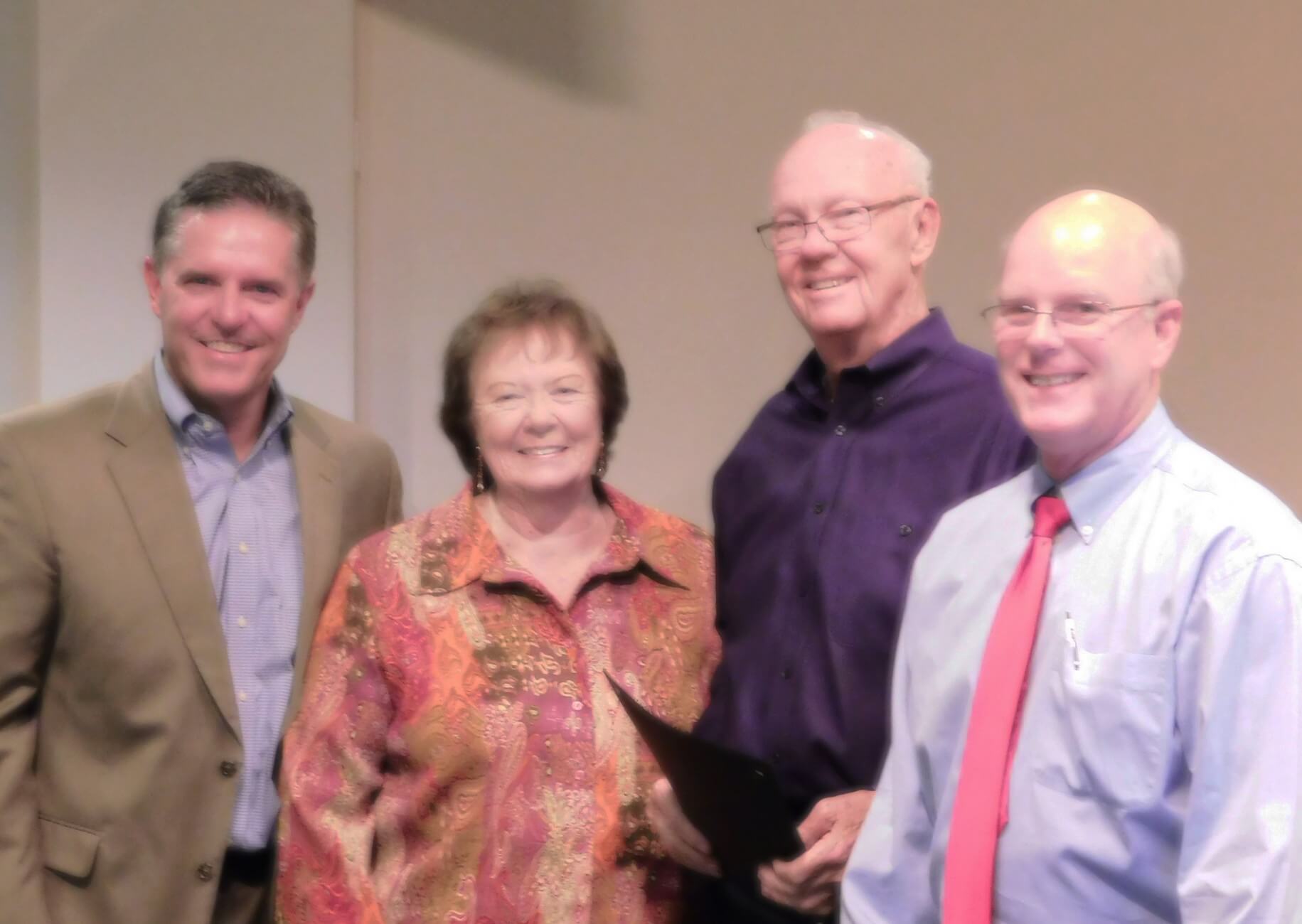
Rufus Honeycutt is recognized for a lifetime of service to country, church, and community. A Vietnam veteran, he later became a Troop Support Coordinator, and was commended for outstanding contributions to the armed services blood programs. He was later awarded the Commanding General’s Excellence Coin, and received a Presidential appointment to the Selective Service System Board.
Since moving to Round Rock he has served two terms on the City Council, led service organizations including Hope Alliance and Sertoma, and currently serves on the Williamson Central Appraisal District Board of Directors and the Round Rock Veterans Monument committee. He and his wife Margaret created the Arts Development Fund to promote the fine arts and cultural events to enhance the quality of life in Round Rock.
Bonnie Horowitz
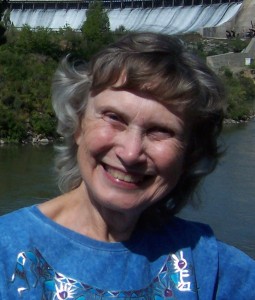 Bonnie Horowitz is recognized as a Local Legend for her almost 30 years of service and advocacy in support of the library and literacy programs in Round Rock. She has volunteered at the library since 1987, organizing fundraisers with the Friends of the Round Rock Public Library in support of the library collection and summer reading program for children.
She has also volunteered thousands of hours to the Literacy Council of Williamson County, organizing fundraising events and serving on its Board of Directors, as well as working directly with clients to help them get a GED, find employment, learn English, become citizens, and solve a myriad of life issues. In just the last year she has volunteered 1,564 hours to the Literacy Council (averaging almost 30 hours per week), and worked with 30 different clients. Over the last 28 years she has helped hundreds of residents support their families and build a strong community.
St. William Catholic Church
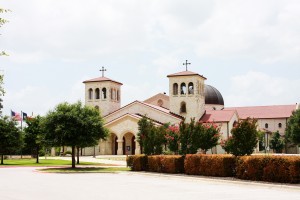 Round Rock’s first Catholic congregation was organized in 1916 by recent immigrants who had fled the Mexican Revolution and found work at the Round Rock White Lime Company. Since building its first church 75 years ago, the church is now the largest parish in the Diocese of Austin.
Since then the church has rapidly outgrown campus after campus. Today, Saint William has over 6,000 registered families and 128 active ministries. A few of these services to the greater Round Rock community are the Annie’s Way Thanksgiving Dinner, and the St. Vincent de Paul Society, which in the last year has served over 5,500 of our neighbors in need through intervention and counseling services, a food pantry, and over $300,000 in direct aid. Saint William is proud of the work their parishioners do to strengthen the community and its neighbors.
Washington Anderson (1817-1894)
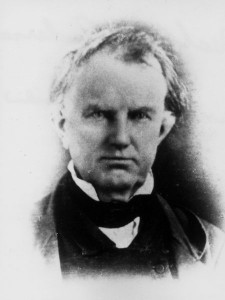
Washington Anderson was one of Round Rock’s founding settlers; there are few events in its early history that he was not associated with. In 1841 Anderson claimed the quarter-league northwest of Kenney Fort that he’d earned for service in the Texas Revolution, where he was considered an unsung hero of the Battle of San Jacinto. He built the Milam District’s first saw and gristmill, and in 1848 he circulated and signed the petition to form Williamson County out of the Milam District, later becoming one of its first Commissioners. In 1868 he provided land for the Greenwood Masonic Institute, the first secondary school in the area.
During this time he built two houses that are now Registered Texas Historical Landmarks. The first was a seven-room stone home built from 1855-59 on the north bank of Brushy Creek to replace the original log cabin. The second house was built for his only daughter Chloe, who lived in Austin but brought the children to visit during the summer. This building is now the Family Life Center at the First united Methodist Church.
But his most significant contribution to the development of the community was selling 150 acres to the International and Great Northern Railroad in 1876 to bring a depot and establish what is now downtown Round Rock (which he had hoped would be named Andersonville). The railroad transformed the community from a frontier village to a bustling small town.
Vander Clyde Broadway “Barbette” (1899-1973)
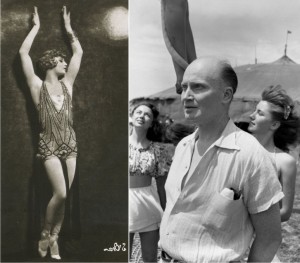
Barbette was the stage name of Vander Clyde Broadway, an aerialist and female impersonator of the 1920s and 30s. As a child in Round Rock he visited the circus and became fascinated with the high wire act. He began practicing on his mother’s clothesline, and (according to legend) on the steel bridge over Brushy Creek.
After graduating early from Round Rock High School, he went to San Antonio to audition for the aerialist act The Alfaretta Sisters. One of the sisters had died unexpectedly, and Vander was hired as her replacement when he agreed to perform as a woman. He later incorporated this impersonation into a solo act that made him famous, and by 1923 he was performing throughout Europe at such venues as the Moulin Rouge and Folies Bergère in Paris.
While most aerialists of the day performed tricks, Barbette’s act was more theatrical. He would perform on the tightrope and trapeze in full drag, then pull off his wig and strike exaggerated manly poses. The provocative act made him the toast of the Parisian avant-garde; Jean Cocteau wrote that “I myself have seen no comparable display of artistry on the stage since Nijinsky.” Cocteau later wrote an influential essay on the nature and artifice of theater called Le Numero Barbette, which was illustrated with images of Barbette getting into costume taken by surrealist photographer Man Ray.
In the late 1930s Vander suffered an illness (probably polio) and became an aerial choreographer and trainer for several circuses and films. His work at Ringling Brothers was described as reinventing aerial ballet. Later he was hired to coach Jack Lemmon and Tony Curtis on gender illusion for the film Some Like It Hot.
He spent his last months in Round Rock with his sister, and died in 1973. His life and work have also inspired more recent pieces, including the 1993 performance art piece Light Shall Lift Them and the 2002 play Barbette. The Texas Historical Commission has recently approved an historic marker about Barbette, to be placed at his gravesite in Round Rock Cemetery.
Watch video of the presentation from the October 23, 2014 City Council Meeting (click on agenda item E.2 to skip to the presentation)
Lambert Peterson
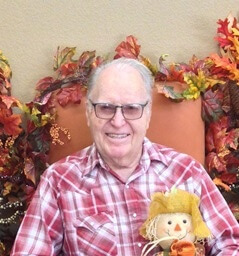 Lambert is honored for his long service to the community, and particularly for sharing recollections and photos (from his own life and from his Swedish pioneer grandparents), which have been an invaluable contribution to our understanding of Round Rock’s history and the personalities that shaped it. Lambert himself grew up speaking Swedish, and is currently the oldest living (male) member of Palm Valley Lutheran Church. He is the oldest living graduate of Round Rock High School (class of 1934), where he lettered in football. He worked at the famous Round Rock Cheese Factory during the depression, and later for Round Rock schools, Trinity Lutheran home, and was instrumental in establishing the Senior Center. Sixteen days shy of their 74th wedding anniversary, Lambert’s beloved wife Margaret passed away. He continues to honor her memory by sharing their experiences so we may learn more about Round Rock’s historical journey.
Sharon Prete (1943-2013)
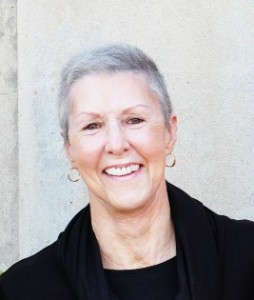 The City’s award-winning parks system and recreation programs have been largely shaped by Sharon Prete during her 25 years as Director of the City of Round Rock Parks & Recreation Department. Sharon was instrumental in the acquisition of several hundred acres to create what we now know as Old Settlers Park at Palm Valley, the crown jewel of the parks system she helped create. All who worked in the Department respected Sharon as a trusted, passionate leader. Upon her retirement, Sharon founded the People and Parks Foundation as a way to continue giving to the community and parks system that she loved. In recognition of her leadership and service, in 2012 the new downtown plaza was dedicated in her name as the “Sharon Hart Prete Main Street Plaza.”
Sheriff James Milton Tucker (1843-1907)
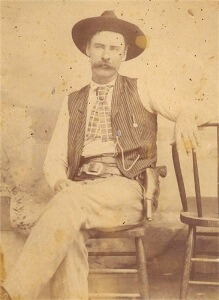 James Milton Tucker was a Williamson County Sheriff and is credited with apprehending the famous outlaw Sam Bass in 1878. Bass had attempted to rob a bank in Round Rock, killing Deputy A.W. Grimes in the process. Although Bass had been wounded, local lawmen did not immediately pursue him because they were not sure whether other members of his gang might be waiting in ambush. The next day Deputy Tucker joined a company of Texas Rangers and followed Bass’ trail into the woods, where he and another searcher noticed a man propped against a tree. Tucker approached the man, who identified himself as Sam Bass, surrendered, and handed over his gun. Bass died of his wounds shortly thereafter. Tucker later served as Williamson County Sheriff from 1881 to 1884, and was known as a fair and friendly man with a kind word for all.
Texas Baptist Children’s Home
 Over its 64-year history, Texas Baptist Children’s Home has provided care for tens of thousands of local children and families. It was founded in 1950 with a donation of land and five buildings from Louis and Billie Sue Henna. Ideas about child welfare were shifting away from institutional orphanages, and the campus was one of the first to be designed as a cluster of cottages, each with a pair of house parents. The cottages are grouped around the Hankamer-Fleming Chapel, a prominent landmark at the intersection of Mays and Palm Valley Boulevard. Building, furnishing and staffing the cottages was a community project, and the campus dedication event was so big that the Chamber of Commerce voted to close their businesses so that all their employees could attend.
Today the Home’s ministry includes both residential and non-residential programs, serving 1,956 people in 2013 alone. Up to 40 children stay in five Campus Life cottages, where they live in a family-like setting with married house parents, attend public school, and participate in extracurricular activities. The Family Care program provides residential care for about 40 mothers and their children while the mothers work to improve their job skills and/or continue their educations. The non-residential HOPE Services program reaches out to children and families at their homes in local apartment complexes. Through these programs the Home and its community partner organizations provide vital support to Round Rock’s most vulnerable children, helping them and their families to reach their full potential.
Watch video of the presentation from the November 14, 2013 City Council Meeting (click on agenda item E.1 to skip to the presentation)
Rev. Freeman Smalley (1790-1881)
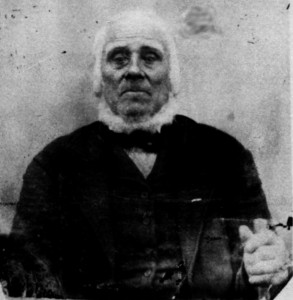 Freeman Smalley was a Baptist minister who preached tirelessly to frontier settlements in the earliest days of Williamson County. He became a preacher after serving in the War of 1812, and followed his sons to Williamson County in 1847, settling near Kenney Fort. He preached wherever he could, and co-founded the Andice Baptist Church and the Anti-Slaveholding Union Baptist Church in the Palm Valley area of Round Rock.
Smalley had a difficult time holding a congregation together because he preached against slavery, and remained a staunch supporter of the Union through the Civil War. For this he was robbed and faced threats of retaliation. In 1866 he left Texas and sold his land to Captain Nelson Merrell, who later built his home there. The Anti-Slaveholding Union Baptist Church was never built, but its graveyard still sits off of A.W. Grimes Boulevard. It is often referred to as the Smalley Cemetery because of its association with the family.
Jack Jordan (1872-1959)
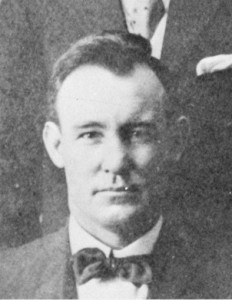 Jack Jordan was the first Mayor under the city’s 1912 incorporation, serving from 1913-1914, but was most influential in his 44 years as City Secretary. For most of that time he was its only paid employee, and he organized and performed most of the administrative processes that are now the functions of the City Clerk, City Manager, Tax Assessor/Collector, and Census-taker. He worked closely with Lyndon Baines Johnson, Round Rock’s congressman, to secure WPA funds for the city’s first water system (the water tower) and the city hall and fire station which stood where the library is now. He retired in 1958 at age 86.
Bob Bennett
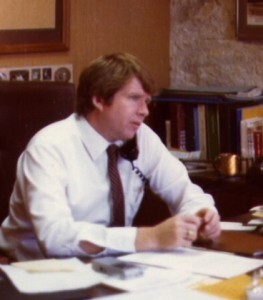 Bob Bennett was the City Manager of Round Rock between 1979 and 2002, when its population grew almost six fold from 12,000 to 71,000. He led the city to create a firm foundation for its growth by securing a long-term water supply, expanding city parks, services and facilities, and selectively recruiting major employers. During his tenure the City created a regional wastewater system, its credit rating improved from triple-B to double-A, the City opened its first golf course at Forest Creek, Dell Computers brought their headquarters to Round Rock, and the Round Rock Express began playing baseball at the Dell Diamond. He also created a supportive working culture at the City, and encouraged staff to expand their skills and leadership.
The Stagecoach Inn (built 1848-1853)
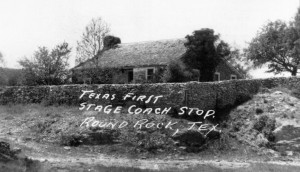 Built between 1848 and 1853 by John J. and Susie Anna Harris, is one of the three oldest surviving buildings in Round Rock. The Inn was built on the Old Military Road (Chisholm Trail) soon after regular stagecoach service was established, using limestone quarried from the slope below. The Inn was a place for travelers to eat and rest, for the drivers to change horse teams, and for locals to receive mail and packages. Townspeople would gather at the Inn when they heard the Harris’ geese honking at the stagecoach’s arrival. Overnight visitors were not as common, but notable guests include Texas Ranger Ira Aten, cattleman Print Olive, famous con artist Soapy Smith, and outlaws John Wesley Hardin and Sam Bass. After the railroad redirected most business activity to “New Town,” the Inn was used as a tavern, home, and later a restaurant. It has never been vacant, and currently houses the French Quarter restaurant. The future of the Inn is uncertain because it lies in the path of necessary improvements to RM 620.
Dr. Thomas Kenney (1805-1844) and Kenney Fort
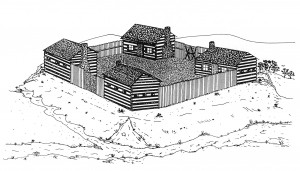 After serving in the Black Hawk War and the Texas Revolution, in 1838 or 1839 Dr. Kenney built a fort on the south bank of Brushy Creek that was the first permanent settlement in what would become Williamson County. Kenney Fort offered shelter and protection for travelers, trappers, surveyors and others, enabling settlement of the area. It also played a key role in several significant events in early Texas history, including the Santa Fe Expedition and the Archives War. In 1844, Kenney and his companions were killed by Caddo or Tawakoni Indians while delivering a wagonload of buffalo hides to market. By the mid-20th century, nothing remained of the fort. A historical marker sits a half-mile north of the site on US 79.
Elmer A. Cottrell (1910-1979)
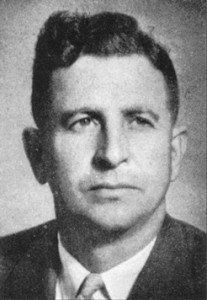 Mr. Cottrell moved to Round Rock in 1948 to manage the Round Rock Cheese Factory, which was then one of the town’s most important industries. He was elected to the City Council in 1950 and was Mayor from 1965-1968. His contributions to the community included starting the Round Rock Recreation Board, serving the Boy Scouts and FHA, and advocacy for preserving some of Round Rock’s historic places, including the wagon ruts in Brushy Creek, the Palm House (now the Chamber of Commerce), and the Round Rock railroad depot (now the Sam Bass Theater).
Louis Henna, Sr. (1914-1990)
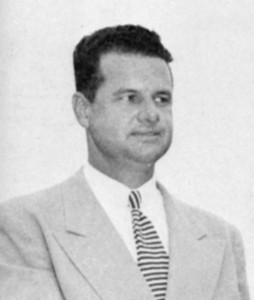 Henna was born in Round Rock. The garage and filling station he started in the 1930s is still operating today as a family owned and operated business, Henna Chevrolet. He also served on the Round Rock City Council and was the Mayor of Round Rock from 1952-1956. Louis Henna Boulevard (SH 45) in Round Rock bears his name.
In 1950, Louis and Billie Sue Henna donated 112 acres of land and five buildings for the Texas Baptist Children’s Home. In the 55 years since it began, more than 20,000 children and their families have been served in residential and non-residential programs. This legacy will continue to reach thousands of children and families in crisis for years to come.
Oliver Leppin, Sr. (1917-1993)
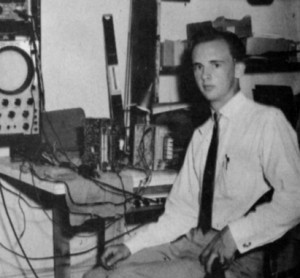 After serving in WWII as an NCO with the Army Air Corps in Italy, North Africa and the Persian Gulf, Oliver and Imogene moved their family to Round Rock in 1948 and quickly made it his home town. He was employed by Austin White Lime until he founded his own company, Leppin Engineering.
For many years Mr. Leppin also was active in the Round Rock Chamber of Commerce where as its president he was instrumental in establishing Frontier Days. He gave many hours to the Round Rock High School Band Boosters, and was a longtime member of the Round Rock Volunteer Fire Department, often the first responder to the fire alarm, and served as secretary, president, and City Fire Marshal.
Robert L. “Buck” Egger (1896-1973)
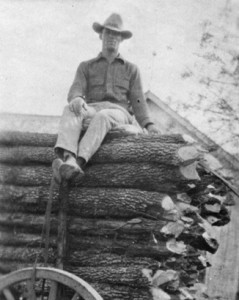 Egger’s family moved to Round Rock in 1896, when he was just six weeks old, settling in the Washington-Anderson House, now a historic landmark. Later he and his wife Stella started a local dairy offering home delivery. In the late 1930s they opened Egger’s Tavern next to their home on South Mays Street, which attracted Fort Hood servicemen, travellers on US 81 (Mays) and locals with food, drinks and live entertainment. Later he was a director of Farmers State Bank.
Mr. Egger was a volunteer firefighter for many years, and was a member of the business planning committee that brought the Westinghouse plant, a major employer, to Round Rock. In 1955 he started developing some of his land as Round Rock’s first residential development, Eggers Acres. In the early 1950s he donated land for the city’s first Little League ball field, Buck Egger Park on South Mays Street.
Jacob M. Harrell (1804-1853)
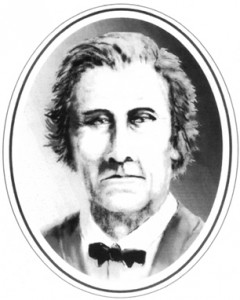 Jacob M. and Mary McCutcheon Harrell, along with other family members, came to Texas from Tennessee with Robertson’s Nashville Colony in 1833. The Harrell families were among the first to settle in the area later called Waterloo (Austin). Harrell was Austin’s first blacksmith, and hosted General Mirabeau Lamar on a hunting trip that ultimately led to the selection of Austin as the Capital of Texas. He sold his homestead for the site of the state capitol, and in 1847 was elected mayor of Austin.
He later chose to move his shop and house to his land grant on the north bank of Brushy Creek in the spring of 1848. There he began selling lots that would become the town of Round Rock. He and Washington Anderson were elected as two of the first four Williamson County commissioners. The family cemetery that he established can be visited today at the intersection of Bowman Road and Interstate 35. Jacob Harrell is buried there along with other family and household members.
“Residents honored for their contributions,” Community Impact 10/2/10
Judy McLeod
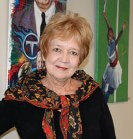 Ms. McLeod is honored for her work and advocacy on behalf of education, children’s organizations, health care and the arts during her 37 years in Round Rock. One of her proudest accomplishments was her role in organizing Court Appointed Special Advocates (CASA) of Williamson County, which guides foster children through the legal system. She has also served as chairperson of Project CARE (a student peer-support program), on the RRISD Board of Trustees and District Council of PTAs, Dell Children’s Hospital Circle of Friends, the Seton Medical Center Foundation’s Board of Directors, and as President of the Round Rock Symphony Orchestra.
Martin & Francinn Parker
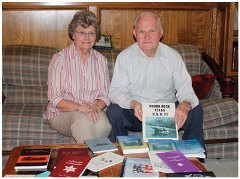 Mr. and Mrs. Parker have devoted a great part of their lives to the community, its history, and to preserving the stories of our local military servicemen and women. After serving in the Navy during WWII and Korea, Martin returned home, where as Postmaster he named several Round Rock streets. Together the Parkers have been foster parents, Sunday school teachers, costumed guides for the Old Settlers Association, and have written several books, including Historical Round Rock: Sesquicentennial 1854-2004, several collections of stories from local servicemen and women, a cookbook, their autobiographies, and several books about their travels.
Dr. Robert Peters (1933-2012)
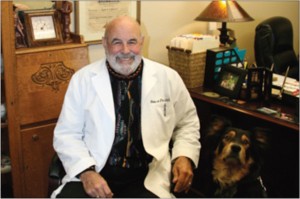 Dr. Peters founded his medical practice in 1972, when Round Rock’s population was under 3,000. Dr. Peters was then the only practicing physician in town, and frequently donated his services. For more than 38 years he has served as physician for the Texas Baptist Children’s Home and the Round Rock High School football team, attending nearly every game to care for the team’s athletes. He was instrumental in recruiting the City’s first hospital (which was an important contributor to the City’s growth in the 1980s), where he has served as Chief of Staff, Chairman of the Department of Medicine, and on the Board of Trustees. Dr. Peters profile, Community Impact 1/8/10; Dr. Peters tribute, Community Impact 01/13/12
Nancy and Virg Rabb
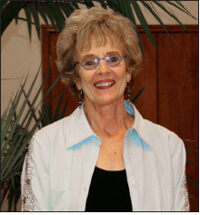 Mr. and Mrs. Rabb started Wag-A-Bag Convenience Stores in 1964, bringing convenience goods to areas too small to be served by larger stores. Virg Rabb served on the City Council and was a civic leader involved in many activities, including the Kiwanis and Frontier Days Committee. In 1989 he donated their home to the City for a park and event facility.
Early in her career, Nancy Rabb brought regular radio coverage to the Round Rock area through her broadcast on KGTN. She has worked tirelessly to support the community, particularly children’s programs, including serving as Chair of the YMCA, the United Way, Williamson County Juvenile Services Council and Williamson County Judicial Council.
Rose Marie “Posey” McClung
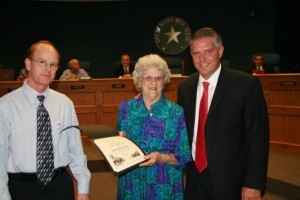 Ms. McClung is know as “the Daffodil Lady” for her efforts organizing the annual festival and for her work with State Senator Ogden to secure the “Daffodil Capitol of Texas’ title for the City. She helped found the local chapter of the AARP and has contributed her talents to many, many volunteer organizations, including the Senior Center, Meals on Wheels, Coats for Kids, St. Williams Church, the Outlaw Trail Ride and the Adult Day Care Center. (L to R: HPC Chair Jerry Hodges, Ms. McClung and Mayor Alan McGraw)
Earl Palmer (1928-2013)
Mr. Palmer shared that his service to the Round Rock community began when he was recruited into the Chamber of Commerce by Doyle Hickerson in 1978. “Doyle was in a contest with Jack Hoover to recruit members; the winner (Doyle) got a fancy jacket.” Mr. Palmer served on the City Council as Round Rock’s Mayor Pro-Tem for 10 years, was president of the Round Rock Chamber of Commerce, and also served on the Historic Preservation Commission and many service organizations.
The Nelson Family
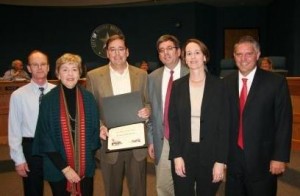 One of Round Rock’s early Swedish immigrant families, the Arvid and Emma Nelson Family settled in Round Rock in 1854. They helped to build the community through entrepreneurship in farming, ranching, and banking. Their son Andrew Nelson was a founding member of Palm Valley Lutheran Church and helped other Swedish families come to Round Rock. Several family homes and businesses are now historic landmarks, including the Merrell House (1860), the Nelson-Crier House (1895), Nelson Hardware Building (1900), and the Palm House (1873), which was moved downtown in 1976 and now houses a museum and the Chamber of Commerce. (L to R: HPC Chair Jerry Hodges, Carol, John, Tom and Rebecca Nelson, Mayor Alan McGraw)
The Avery Family
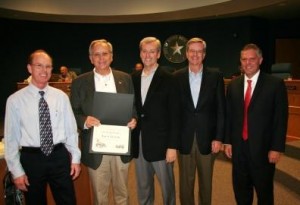 Over the years, Avery Family members have made very generous monetary and property donations to the community. They are related to the Nelson Family through their grandparents’ marriage in 1904. The current generation facilitated the development of Seton Williamson Hospital, and recently donated land for the Round Rock campuses of Texas A&M University, Austin Community College and the Round Rock Higher Education Center. (L to R: HPC Chair Jerry Hodges, Charles, Nelson and John Avery, Mayor Alan McGraw)
No awards 2007-2008
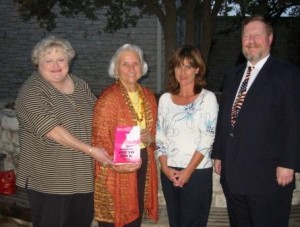
Thomas C. Oatts (1815-1885)
Thomas C. Oatts was Round Rock’s first postmaster and gave the city its name. In 1851 he opened the Brushy Creek Post Office in his store on the stagecoach route that is now called Chisholm Trail Road. In 1854 the US Postal Service asked him to provide a different name for the settlement, as there was already a town in Texas called Brushy. Mr. Oatts decided to rename the town “Round Rock” after the large rock in the middle of Brushy Creek that marked a low water crossing, and where he and Jacob Harrell enjoyed fishing. On August 24, 1854, the community was officially named Round Rock. Mr. Oatts’ Award was accepted by his great-great-granddaughter, Nan Elizabeth (Betsi) Schaefer.
“Historical Round Rock” (book) by Jane H. DiGesualdo & Karen R. Thompson
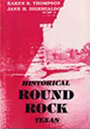 When Karen Thompson and Jane DiGesualdo (independently) began giving classroom presentations on local history in the early 1980s, the teachers invariably asked about additional historical resources. Frustrated by the lack of written material, the two met and began writing a book about the history of Round Rock. After much research and hundreds of interviews, the book topped out at 583 pages with over 400 photographs. Today it is almost sold out of its second printing. The book is an essential reference for locals and history buffs, and has itself become a local legend.
No awards 2003-2005
The Hester Family
Elmer Hester, the family patriarch, was born in Round Rock in 1908 in a farmhouse near where IH-35 crosses Lake Creek, and died in 1990. He worked for HEB before opening his own business, Peterson’s Meat Market. He and his wife Ruby had five children, who have been key businesspeople in the city, together owning as many as seven businesses in Round Rock. Son Dale Hester served on the City Council from 1965 to 1969 and as Mayor until 1973. Son Lawrence “Hank” served two terms on the City Council, between 1960 and 1962, and from 1979 to 1981. Gail “Big Boy” opened his auto repair shop at the age of 22 and has been a leading member of the Chamber of Commerce who played an instrumental role in getting the Round Rock Express to relocate here. Hesters Crossing is named for the family.
Allen R. Baca (1921-2002)
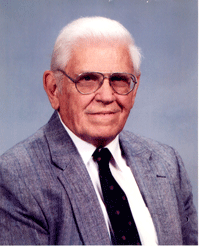 After serving in the Air Force during WWII, where he earned an Air Medal and the Distinguished Flying Cross, Alan Baca and his family moved to Round Rock in 1976. While working at the Texas Commission on Jail Standards and the Texas Department of Aging, he recognized a need for literacy and GED assistance for people on probation and for senior citizens, and his education program for seniors was implemented in almost 100 senior centers across Texas. He started Grandparents’ Day in Texas and convinced Governor Mark White to declare a special day in honor of the state’s mature residents.
In Round Rock he served on the Planning & Zoning Commission, and in 1990 led the effort to create the nonprofit Round Rock Senior Citizens Foundation and convert a vacant bank building to Round Rock’s first Senior Activity Center. In 1994 the Round Rock Chamber of Commerce recognized his community service and named him Round Rock Senior Citizen of the Year. He later received the National Daily Points of Light Award, which honors individuals and organizations that connect Americans through service to help meet critical needs in their communities. In 2006 the Alan R. Baca Center for Senior and Community Activities was named for him in recognition of his accomplishments and his work on behalf of the Round Rock senior citizen community.
LaVerne Reinhardt (1924-2012)
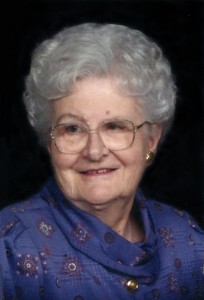 A lifelong resident of the Hutto and Round Rock areas, Helen LaVerne Reinhardt was named a Local Legend in recognition of her service and commitment to the Trinity Lutheran Home and its residents. She began her career at Trinity as a secretary, and was named its Administrator in 1972, a position she served for the next 19 years. While managing the home through a busy period of the home’s growth and several facility expansions, she also played the organ for daily chapel services and remained personally engaged with the residents in her care. After retirement she continued to play the organ and volunteer at the home whenever needed. She was also an active member of Palm Valley Lutheran Church.
Norman Gus “Bunky” Whitlow
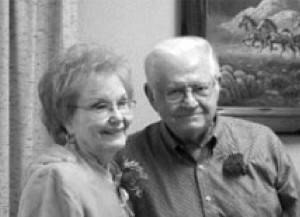 Mr. Whitlow was a Round Rock teacher and principal before becoming president of Farmers State Bank. Bunky was known as “the poor man’s banker” and he and his wife Geneva (pictured) helped to build philanthropy in Round Rock by helping countless people onto their feet when they needed a hand up.
Ellen Davis
Ellen Davis was recognized for sharing her recollections of life in early Round Rock. Born Ellen Blair in 1895, she lived and worked her entire life in and around Round Rock. She recounted tales of her life on her family’s farm in Merreltown, driving a tractor, stacking hay, picking 50-lb bags of cotton with a child in tow, milking cows and taking the milk to the cheese factory. She remembered making trips to Gatesville in a covered wagon during her childhood, and was nearly attacked by a panther while making a buggy trip with her children through Fern Bluff (near Hairy Man Road). Ellen was married to Lonnie Davis for 66 years and was blessed with five children, 13 grandchildren, 30 great-grandchildren and 29 great-great-grandchildren. Mayor Robert Stluka proclaimed April 8, 2000 as Ellen Davis Day in honor of her 105th birthday and presented her with a bouquet of roses.
Marcia Hilsabeck
Ms. Hilsabeck was recognized for her contribution to promoting academic excellence at Round Rock High School, where she has taught since 1967. She has been teaching Advanced Placement English Literature since 1980, and has been a consultant for the College Board since 1981. She is the Lead English Consultant in the TCU Advanced Placement Summer Institute, and developed and teaches an online course for Virtual High School.
No awards 1999
Lone Star Bakery
 The Lone Star Bakery has been a local institution since its founding by Reinhold R. Moehring in 1926. Its beloved Swedish rye bread and yellow “Round Rock Donuts” have become favorites; the donuts have received numerous accolades, from Texas Monthly’s 1978 “best donut in Texas” to more recent mentions in various travel guides and blogs.
Robert G. Griffith
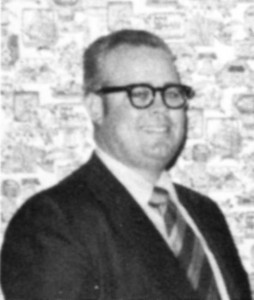 A Round Rock resident for over 40 years, Mr. Griffith’s service to the community began with his career as a teacher, coach, Jr. High and High School Principal for the Round Rock ISD. He served on the City Council and as Mayor. He was also active in many civic organizations including the Kiwanis, Round Rock Volunteer Fire Dept, YMCA of Greater Williamson County, Texas Independent Bankers Association, Round Rock United Way, Palm Valley Lutheran Church and the American Red Cross. In 1999 the expanded public library was named in honor of Robert G. and Helen Griffith. He passed away on May 20, 2012.
Florentino “Tino” Hernandez
Born and raised in Round Rock, Mr. Hernandez returned to his hometown after earning a BA at St. Edwards University and careers at the Austin State Hospital and Liberty Mutual Insurance in San Antonio and Oklahoma City. He is recognized for his extensive service record with the Kiwanis, Big Brothers/Big Sisters, Round Rock High School’s Careers in Technology program, the United Way Board, El Amistad, Sertoma, the Round Rock Chamber of Commerce and Board, St. Williams Church and the Lions Club, with whom he visits Mexico twice a year for service projects.
Trinity Lutheran Home
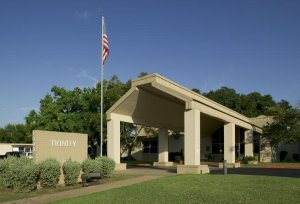 Trinity Lutheran Home is recognized for over 90 years of quality convalescent care to the elderly. The home occupies the site of the former Trinity Lutheran College, which operated from 1906 until 1929, when it merged with Texas Lutheran College in Seguin. Stones from the college’s main building were used in the construction of the new buildings.
Ben Salazar
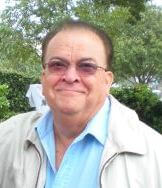 Mr. Salazar is a lifelong resident of Round Rock who served on the City Council from 1970-1972. He is also an active member of the Round Rock Community Service Council, St. Williams Catholic Church, and El Amistad, where he has served in varying capacities as Chairperson, Treasurer and President. He is recognized as a role model who frequently assisted others with health and financial problems.
Grace Telander
Ms. Telander is a lifetime resident of Round Rock and member of Palm Valley Lutheran Church, whose grandparents moved to Round Rock from Sweden in 1860 and established the family farm (in part of the Palm Valley area that is now between US 79 and Brushy Creek). Mrs. Telander is also recognized for volunteer work with Trinity Lutheran home and Meals on wheels. In 1974 the Telander family received a Texas Land Heritage certificate honoring the farm’s 100 years in the same family. In 1996 Mrs. Telander and her family opened their home to the Round Rock community during the Christmas Homes Tour.
See Round Rock Leader article, January 27, 1997 (pdf)
Harriet Rutland
Ms. Rutland is a building contractor who undertook the rehabilitation of several historic Round Rock structures, including the Old Post Office and St. Charles Hotel on Chisholm Trail, and the Rose Cottage and Poker Alley in the Old Town area. Her efforts led to the creation of the Chisholm Trail Historic Overlay Zoning District.
Tom Lopez
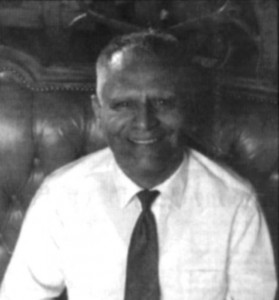 In 1948, Mr. Lopez was the first Hispanic male to graduate from Round Rock High School. After 20 years in the Air Force, he returned from military service to work for the IRS and the Round Rock ISD. He became a community leader, serving three terms on the City Council, and as an active member of the American Legion, El Amistad, Round Rock Recreation Board, Community Services Council and as Little League coach. Round Rock Leader 2/13/97 (pdf)
Pete Correa
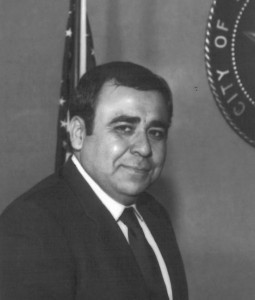 Mr. Correa served on the Round Rock City Council from 1978 to 1991, and also owned and operated Correa’s Automotive on Bagdad Street. He is also a member of El Amistad and St. Williams Catholic Church.
Betty Porter
Ms. Porter is recognized for her contributions to the community as a history, art and drama teacher. She helped found the Sam Bass Theater Association and directed the Sam Bass Shootout at Frontier Days for 20 years. She and her husband Jim also restored the Barker-Porter House, built in 1872. See nomination statement, 1995 (pdf)
Xenia Voigt
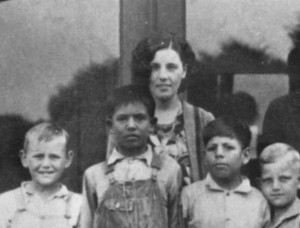 Over her 48-year career, Ms. Voigt taught three generations in Round Rock. She also served on the board at Palm Valley Lutheran Church and raised two nieces after their mother died. Ms. Voigt’s teaching services to the community were honored when Xenia Voigt Elementary was named after her in 1975. Round Rock Leader 1/4/96 (pdf)
Lt. Col. William Todd
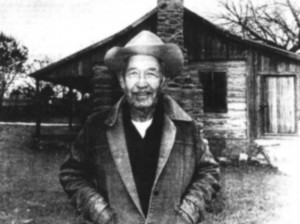 After a military career in which he served in WWII and Korea, Col. Todd’s family retired to Round Rock, where he distinguished himself as a local historian. He persuaded a developer to preserve a pioneer homestead in Wells Branch, which became the centerpiece of the development. He became the homestead’s folklorist (more familiarly known as its “resident liar”), giving tours and entertaining schoolchildren with tales of the old west. He also maintained a booth as a folklorist at the Texas Folklore Festival in San Antonio and helped establish and build the St. Richard Episcopal Church of Round Rock. Round Rock Leader, 12/28/95 (pdf); Obituary 6/12/11 (pdf)
Garfield McConico
Mr. McConico was a local businessman who served as City Councilman from 1969-1971 and as the city’s first black Mayor Pro-Tem from 1971-1977. He was instrumental in hiring the city’s first professional Manager and in recruiting Westinghouse Corporation to locate in Round Rock. The McConico building is named in honor of Garfield and Petronella McConico, and stands on land they owned in downtown Round Rock.
Lerlene Ward
Ms. Ward was a dedicated volunteer for many service organizations in Round Rock, including the Old Settlers Association and especially the volunteer fire department. She was a member of the Girls Pumper Team, which was formed to compete in fire department pumper races during World War II while many firefighters were overseas. In its first year the Round Rock team beat half the competition and became famous throughout Texas, touring the state through the 1950s and promoting the Round Rock name. Since then, the pumper races have been succeeded by the Firefighter Combat Challenge, which has men’s, women’s and co-ed teams.
O. F. (Oliver Floyd) Perry
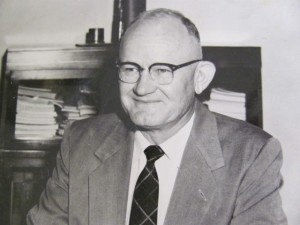 Science Teacher, Coach, Principal and Superintendent O.F. Perry served the Round Rock Independent School District during a formative period from 1931 to 1957. He established a policy of bringing students from around the district to a central high school so that there would be enough students to offer advanced classes, sports, and extracurricular activities. While many teachers were in the services during WWII he coached several boys and girls sports teams. “Coach Perry” is remembered for the energy he devoted to the mentoring and character development of his students and players.
Years after his retirement, Round Rock High School declared November 16, 1973 “O.F. Perry Day,” and at a ceremony before the Dragons football game announced that friends and ex-students had raised funds to dedicate a historic district street lamp in his honor. Observed former student Lerlene Ward, “No other man in Round Rock has molded so many lives… He not only taught us the three R’s but he also taught us sportsmanship, honesty, leadership and everything it takes to be a good, honest, Christian Citizen.” (Hill Country News, 11/16/73)
Noel Grisham
 Raised in Round Rock, Mr. Grisham taught high school English for five years before serving as superintendent of the Round Rock Independent School district for 22 years. During this period the district began to grow very rapidly, and he had to sell the school’s programs carefully in order to get bond issues passed to fund desperately needed facilities. After retiring he served a term in the Texas Legislature representing Williamson and Burnet counties. He has also written or co-authored ten books on Texas history. Round Rock Leader, 12/1/94 (pdf)
Joanne Land
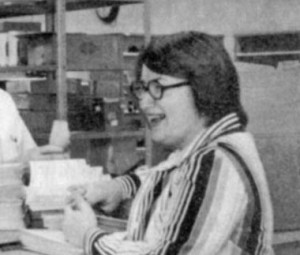 Ms. Land was the City Secretary from 1970-2002, a period when Round Rock’s population grew from less than 3,000 people to more than 60,000. Through this growth spurt she managed the city’s recordkeeping as its government became increasingly complex and professionalized, and is credited with “training” four City Managers during her tenure. The continuity her service provided helped transition smoothly from small town to midsize city. Round Rock Leader, 12/1/94 (pdf)
Claude Berkman
Mr. Berkman was recognized as a respected educator who was and is a positive influence, especially on the children who passed through the Round Rock School system during his tenure as a teacher and principal at Berkman Elementary. Mr. Berkman was born in Round Rock, where he attended Trinity Junior College. After graduating from Augustana College in Illinois, he moved to Lueders, Texas, where he was a teacher, coach, principal, superintendent of schools, and trained to be an instructor for the Army Air Corps. In 1947 he moved back to Round Rock to teach, and in addition served as director of the Old Settlers Association, and as a member of the Kiwanis Club and Palm Valley Lutheran Church.
Billie Sue Henna
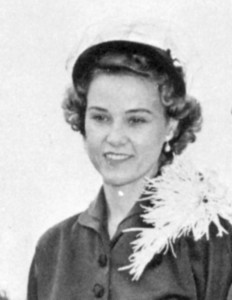 Mrs. Henna was recognized for her contributions to the community and as the matriarch of the Henna family. She and her husband Louis Henna donated land for the Texas Baptist Children’s Home in 1950. She also served as a bible study teacher with the First Baptist Church, member of the Austin Women’s Forum, Austin Women’s Club, Round Rock Women’s Club, and as president of the YWCA in Austin.
Rudolf Pettersen
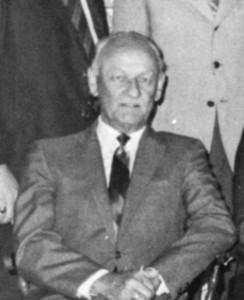 Mr. Pettersen was recognized as a highly respected merchant and leader in the community. After leaving the Army in 1946, he opened Petterson’s Grocery, which he operated until 1973. During this time the store was a focal point in Round Rock, offering a butcher shop, free delivery, charge accounts and employment for local youth. He was a member and officer of the chamber of Commerce, Tax Equalization Board, Palm Valley Lutheran Church, Kiwanis Club and American Legion, and served as a director of both the First National Bank and GOETA Insurance.
Eugene Quick
Gene Quick was recognized as a respected druggist who served the Round Rock community for many years. He graduated from the University of Texas in 1936 and went to work for a drug store in downtown Round Rock, which he later bought and operated until 1980. During World War II Mr. Quick was the only druggist in the area, and frequently opened the store at night to respond to an emergency – often without compensation. He also served with the State Guard during the war, and later as Boy Scout Advisor, Kiwanis member, Palm Valley Lutheran Church officer, and Director of the First Texas State Bank.
Mrs. Thelma “Tiny” McNeese
A resident since 1931, Thelma McNeese is recognized for her service to her church and community, including 35 years of sewing uniforms for the Round Rock pep and cheerleading squads. Obituary, Round Rock Leader, 12/2/91 (pdf)
The Rubio Brothers
Mack and Lorenzo Rubio’s parents moved to Round Rock from McNeil in 1946. Their sister Paula was a WAC in WWII and was one of the first Hispanic students from the Round Rock area to attend the UT Austin. Lorenzo was 13 when the public schools were integrated for Hispanic students. After several years in the Navy, he and his brother Mack opened a grocery store on Rubio Street, which later relocated downtown. In 1968 Lorenzo became Round Rock’s first Hispanic City Councilmember. The next year he and his wife Janie opened the Casa Rubio restaurant. Read the summary of a 1991 oral history interview with Lorenzo Rubio here.
Mrs. Genobeba Rendon (1924-2010)
 Mrs. Rendon is recognized for her kindness and generosity, helping people in times of illness, birth, death and financial difficulty. Wherever she saw people in need she has provided friendship, meals, clothing, and has cared for countless elderly residents. Through the Guadalupanas group at St. Williams Church she assisted with weddings, hospitality receptions, wakes and funerals. Genobeba never had formal schooling but taught herself to read and write in Spanish with the aid of a friend by copying letters from matchbooks. After her father died she single-handedly supported her family and her son Joe working for the Texas Baptist Children’s Home, Trinity Lutheran Nursing Home and for the Four Seasons. “If she knows someone is sick, she’ll go and take whatever she can. Too bad we don’t have more people like that.” Mack Rubio observed when she received the award. Round Rock Leader, 1992 (pdf)
Joe Lee Johnson
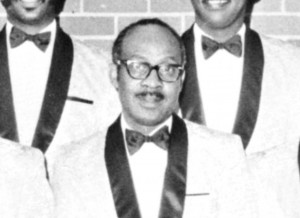 Mr. Johnson is a graduate of the Hopewell School, and later became its much-loved principal. During his tenure there the school was integrated into RRISD in 1966. He continued teaching at Central Elementary and volunteering in the Young Men’s Club. Round Rock Leader, 9/19/91 (pdf)
David Carlin Sr.
The Carlin family was instrumental in establishing Round Rock’s first Catholic church, St. Williams, and helped many newcomers get established in the community. Round Rock Leader, 9/23/91 (pdf)
Rev. Oliver Berglund
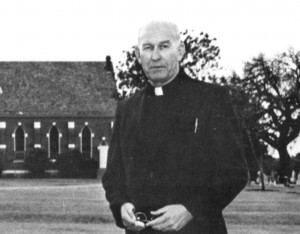 Rev. Berglund was pastor of Palm Valley Lutheran Church from 1969 to 1992, during a very significant period of growth for the church and the city. Round Rock Leader, 9/12/91 (pdf)
The Domino Players
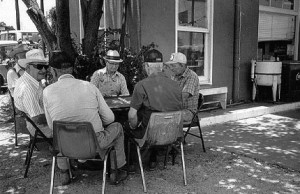 After the Mobil gas station on the northwest corner of Mays and Main began closing early each afternoon in response to the gas crisis on the early 1970s, Mercer Archer, Mr. Kelley, Moody Mayfield, C.J. Miller, L.P. “Doc” Parker, and Garland Walsh began a long tradition of playing dominoes under the tree. Round Rock Leader, 7/15/91 (pdf)
The Old Settlers Association of Williamson County
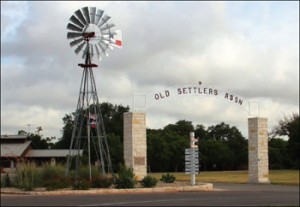 The Old Settlers Association has played a pivotal role in preserving Round Rock’s pioneer traditions and historic buildings. The Association, which raises money for scholarships and other local causes, grew out of confederate soldiers’ reunions, though now membership is open to anyone whose ancestors resided in Williamson County by 1900. In 1988 the OSAWC moved their meeting grounds from the southwest corner of IH-35 and RM 620 (near McDonalds) to its present location on Palm Valley Blvd., donating 100 acres of this tract of land to the City for Old Settlers Park. The Association restored the Palm Mansion and has preserved pioneer log cabins by moving them to their meeting grounds adjacent to the park. They also maintain the Fire House Museum, meeting facilities and an RV travel park there. Round Rock Leader, 7/11/91 (pdf); Community Impact profile 7/3/08