The Round Rock City Council approved a comprehensive update to downtown zoning regulations on Oct. 23, adopting four ordinances that revise the City’s Zoning and Development Code and rezone more than 100 downtown parcels to align with the new standards.
A decade in the making
Originally adopted to implement the 2010 Downtown Master Plan, Round Rock’s downtown zoning districts were created to support a walkable, mixed-use environment that balances retail, dining, housing, public spaces and historic preservation. With growing development interest and evolving community needs, City Council identified downtown mixed-use zoning as a top priority in its most recent Strategic Plan, leading to a full review of existing zoning regulations.
The update builds on years of City investment—more than $228 million in downtown infrastructure, parks, and public spaces since 2001—and incorporates extensive input from residents, businesses and developers gathered through surveys, roundtables, open houses and workshops held throughout 2024 and 2025.
Council approved four related ordinances at its October 23 meeting:
- Amendments to Chapters 1, 2 and 8 of the Zoning and Development Code regarding Downtown Mixed-Use Districts.
- Rezoning of 66 parcels to the MU-2 (Mixed-Use Downtown Medium Density) district.
- Rezoning of 40 parcels to the MU-L (Mixed-Use Limited) district.
- Rezoning of 8 parcels to the OS (Open Space) district.
All rezoning recommendations were recommended for approval by the Planning and Zoning Commission prior to Council’s consideration.
Key updates to zoning districts
Below is a listing of the three major mixed use zoning types with information about updates to each zoning type.
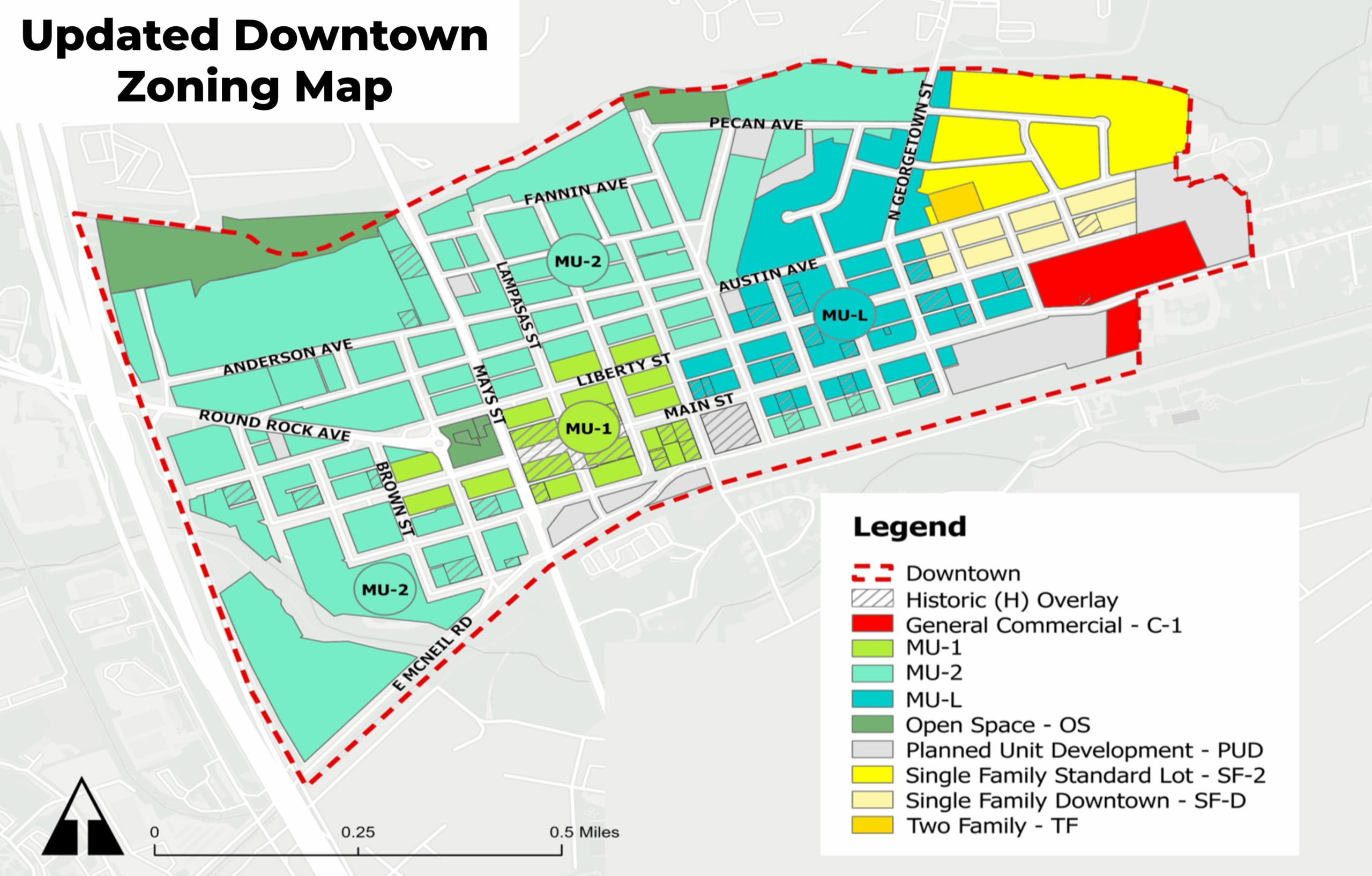
MU-1 (Historic Commercial Core):
Designed to complement the existing two-block National Register Historic District, MU-1 emphasizes retail, restaurant and entertainment uses with upper-story residential, live/work and office options. Updates include:
- New construction must meet Historic Design Guidelines for Commercial Properties.
- Flat roofs with parapets required for all new buildings.
- New permitted use: small-scale manufacturing and assembly with at least 10% of gross floor area as customer-serving retail.
- New bars prohibited; existing bars may continue and transfer under specific conditions.
- Bed and Breakfasts now allowed with standards; vape and smoke shops, game rooms, and veterinary clinics prohibited.
MU-2 (Mixed-Use Downtown Medium Density):
Designed to ensure compatibility with building form and historic character. Major amendments include:
- Four building types based on scale and location, with new design requirements.
- New height limits:
- Up to 8 stories (110 ft) along Mays Street and Round Rock Avenue.
- Up to 12 stories (160 ft) along IH-35.
- 3–4 stories elsewhere in the district.
- Buildings 5–12 stories must include Privately Owned Public Spaces (POPS) such as plazas or courtyards.
- New uses: Enrichment Centers, Wellness Centers, and Small-Scale Manufacturing (with 10% retail component).
- Event centers now allowed with specific standards and restrictions to ensure compatibility with nearby neighborhoods; drive-throughs, game rooms and vape/smoke shops prohibited.
MU-L (Mixed-Use Limited):
Intended to maintain the character of established residential neighborhoods east of Mays Street. Updates include:
- Allows up to three buildings per lot, each 2,800 sq. ft. or less.
- Front setbacks between 15 and 25 feet.
- On-site parking no longer required for nonresidential uses.
- Restaurants and event centers permitted only on Main and Georgetown streets, with design and screening requirements.
- New uses: Enrichment and Wellness Centers (Main/Georgetown only).
- Prohibited uses include game rooms, veterinary clinics, and tobacco/vape sales.
Additional code and signage updates
The amendments also clarify terminology, update definitions and introduce new sections for:
- Downtown food trucks with compatibility standards near residences.
- Foundation landscaping treatments to encourage greenery.
- Sign regulations allowing more flexibility for tall buildings and expanded uses along Main and Georgetown Streets.
Preserving historic character
Round Rock currently has 57 designated landmarks in the downtown area. As part of this initiative, City staff contacted 125 eligible property owners in early 2025 to assess interest in designation, with about 10% pursuing the process. Updated regulations continue to protect and enhance historic resources while encouraging compatible new development.
What happens next
The new zoning and map amendments take effect immediately. Existing uses and buildings that do not conform to the new standards may continue as legally nonconforming, though expansions will require compliance. City staff will now review future downtown development applications using the updated regulations, ensuring consistency with Round Rock’s long-term vision for a vibrant, connected and historic downtown.
To learn more about this initiative, visit www.roundrocktexas.gov/downtownzoning.