
Jump to question
- What is included in the Skybox Old Settlers Planned Unit Development?
- Have changes have been made to the Planned Unit Development?
- Does this project include any incentives?
- Are there options for this development that might add more aesthetic value to the area?
- What value does a data center bring to the community if it doesn’t bring a large number of jobs with it?
- What about traffic?
- What about property values of surrounding areas?
- How much water do data centers use in Round Rock?
- Does a data center’s power needs affect electricity service for Round Rock residents?
- How many other existing data centers are there in Round Rock?
- Do data centers produce harmful containments in their wastewater?
- Is this site appropriate for a data center? What about noise?
- Do data centers cause air pollution?
- Did the City provide notice to the public about this rezoning?
- What happens if the City Council denies this rezoning?
- What is included in the Skybox Old Settlers Planned Unit Development?
- Have changes have been made to the Planned Unit Development?
- Does this project include any incentives?
- Are there options for this development that might add more aesthetic value to the area?
- What value does a data center bring to the community if it doesn’t bring a large number of jobs with it?
- What about traffic?
- What about property values of surrounding areas?
- How much water do data centers use in Round Rock?
- Does a data center’s power needs affect electricity service for Round Rock residents?
- How many other existing data centers are there in Round Rock?
- Do data centers produce harmful containments in their wastewater?
- Is this site appropriate for a data center? What about noise?
- Do data centers cause air pollution?
- Did the City provide notice to the public about this rezoning?
- What happens if the City Council denies this rezoning?
Skybox Old Settlers Planned Unit Development (PUD)
The Skybox Old Settlers Planned Unit Development (PUD25-00009) is a request currently under consideration to rezone approximately 29.69 acres of vacant land located east of N. A.W. Grimes Boulevard and south of E. Old Settlers Boulevard from LI (Light Industrial) to a Planned Unit Development, to allow for a proposed data center. The Planning & Zoning Commission reviewed the request on November 5, 2025, and staff recommended approval. While no formal objections were filed following the City’s public notice process leading up to the meeting, the City received an influx of inquiries from residents with a range of questions and concerns leading up to the consideration of the item by City Council. The zoning was approved by Round Rock City Council on first reading at the Dec. 4, 2025 meeting, and is scheduled for a second reading and final vote on Thursday, Feb. 12 (meeting begins at 6 p.m. in City Council Chambers located at 221 East Main St.).
- Watch live video online (starts at approximately 6 p.m.)
- View agendas for all City meetings
- See past agendas and minutes in our Round Rock Replay archives
This page aims to help provide basic information about data centers in Round Rock and this most recent request.
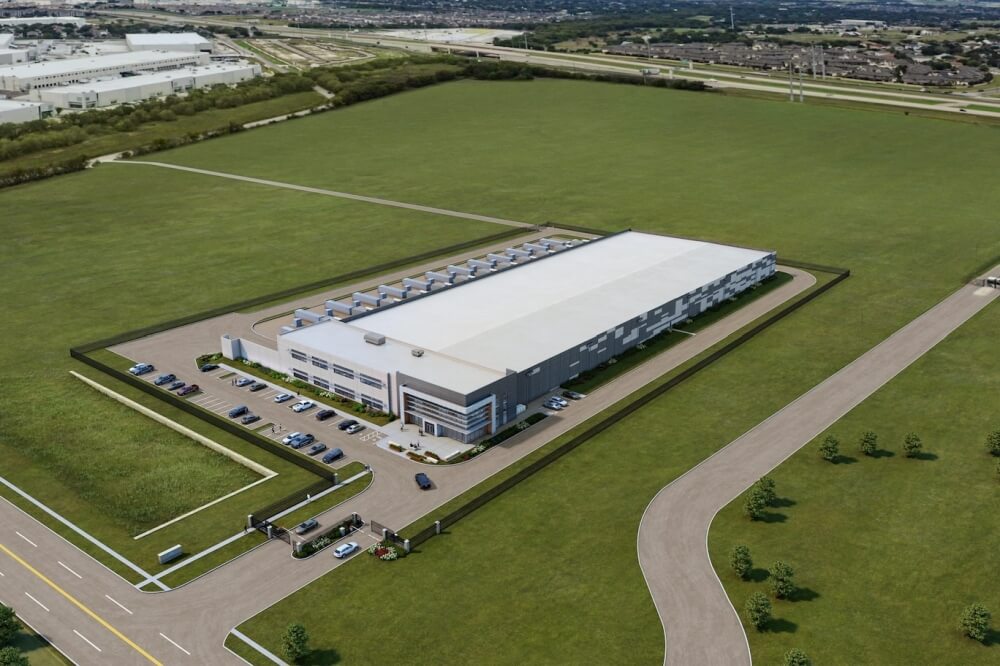
What is included in the Skybox Old Settlers PUD?
The proposed PUD establishes three coordinated parcel areas: Parcel Area 1 for a data center or light industrial use (north side of the property), Parcel Area 2 for an electric substation or light industrial use, and Parcel Area 3 as an open-space buffer providing an 80-foot setback and a 25-foot landscape buffer with a masonry compatibility wall along the Chandler Creek MUD neighborhood to the south. The PUD limits a number of high-impact Light Industrial uses otherwise allowed, requires a closed-loop cooling system, and sets standards for site access, building design, screening, fencing and streetscape landscaping along Old Settlers Boulevard. Up to three driveways may connect to Old Settlers, subject to final design during site development permitting.
Have changes have been made to the Planned Unit Development?
On Jan. 8, a neighborhood meeting organized by the applicant was held at the Marriott Hotel in La Frontera. The meeting was well attended by residents of various neighborhoods around the subject site. Skybox representatives began the meeting by making a short presentation on the project scope and then answered questions from citizens who expressed concerns including but not limited to: particulate matter and/or air pollution from generators, health concerns related to noise (both audible and low frequency), generator testing and operating frequency, invasive site lighting, and the potential for site access from Chandler View Trail.
As a result of the neighborhood meeting and subsequent meeting with city staff, the following provisions were added to the PUD:
• Only one data center building may be constructed. It is limited to 250,000 square feet in floor area, 60 feet in height, and 75 megawatts of grid-interconnected power.
• On-site generators may only be used for supplemental, emergency, and reliability purposes, including but not limited to: utility outages, maintenance, testing, and participation in utility-managed load shedding or demand response programs. This ensures generators will not be used as a primary source of power during normal electric grid operation.
• Generators shall only be installed in parcel area 1.
• Two rows of evergreen trees are required to be planted in the landscape buffer along the southern property line (as opposed to only one row). Large species trees must be a minimum caliper size of 4″ at time of planting and medium species trees must be a minimum caliper size of 3″ at time of planting (as opposed to 3″ and 2″, respectively).
Does this project include any incentives?
No.
Are there options for this development that might add more aesthetic value to the area?
Data centers are generally large, utilitarian buildings. However, Round Rock carefully evaluates each proposal through a Planned Unit Development (PUD) process, which gives the City more control than it would otherwise have under standard zoning.
A PUD allows the City to negotiate important elements—such as how far the building must sit back from the street, how it is screened from nearby properties, and what design features or materials must be used. These are conditions the City cannot require if a developer chooses to build something that is already allowed under the site’s existing Light Industrial (LI) zoning, such as a distribution warehouse with loading docks.
What value does a data center bring to the community if it doesn’t bring a large number of jobs with it?
Data centers provide a strong taxable value with a low “cost to serve,” meaning they don’t require much support from City services. They don’t create heavy traffic and rarely need emergency responses. For the community, that means strong tax benefits, which offset residential property taxes, with minimal ongoing costs.
Data centers do not generate a large number of permanent jobs, and the City does not claim otherwise. Their value comes from taxable real property and taxable business personal property, which provide meaningful revenue with extremely low service demands. Sabey Data Center will pay roughly $800,000 in property taxes toward essential City services such as public safety, parks, library and transportation. The City did incentivize Sabey by funding a portion of the demolition of an aging call center building on the site, which was recouped within months. Equipment housed in data centers is subject to taxation, and a single tenant—such as digital technology service providers otherwise located outside of Round Rock—can generate hundreds of thousands of dollars per year in City property taxes by locating equipment on site. It is important to note that data centers also fund county and public-school services through property taxes while also needing limited services from those agencies. Switch’s business model has the ability to generate higher levels of sales tax, so a sales tax-sharing agreement was approved by the City Council.
What about traffic?
Under today’s zoning of Light Industrial (LI), a property owner could build a distribution warehouse with loading docks, truck traffic and day-and-night shipping activity without requiring City Council approval. Compared to that alternative, a data center is typically much quieter, has little traffic and creates fewer external impacts on neighbors and nearby roads. In other words, while data centers may still have an industrial feel, the “behind-the-scenes” impacts are significantly lower than many other industrial uses that could be built today without additional approval.
The City uses the Planned Unit Development (PUD) process to ensure that any proposal includes appropriate screening, thoughtful site design, and measures that limit noise, traffic and other impacts, resulting in a use that is often more compatible than what could be built under existing Light Industrial zoning.
What about property values of surrounding areas?
Round Rock has not seen any evidence that data centers decrease nearby property values. The Sabey facility, for example, increased the taxable value of its site to approximately $210 million after redevelopment, directly strengthening the tax base. A data center produces no peak-hour congestion, has minimal staffing and remains quiet compared to warehouse or industrial operations that could legally locate on Light Industrial property without additional approval. Those operations are more likely to introduce noise, truck traffic and other factors that can pressure nearby home values. While residents may understandably express concern based on stories from other cities, Round Rock’s recent experience does not show negative impacts on quality of life or property valuations around its existing facility.
How much water do data centers use in Round Rock?
Round Rock maintains some of the lowest water and wastewater rates in the region, and because of decades of proactive planning and diversified supply, the City is in one of the strongest long-term water positions in Central Texas.
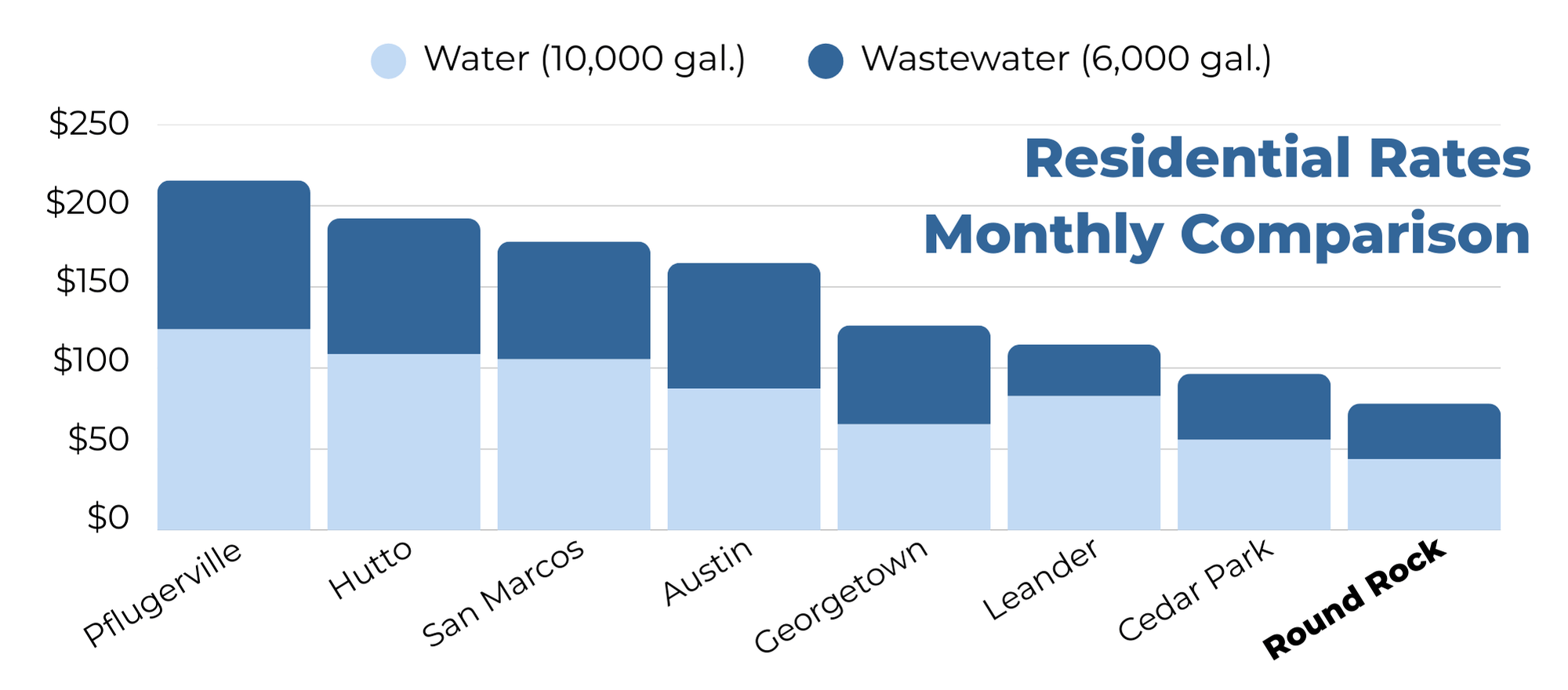
The City of Round Rock monitored water use from Sabey over the past year and found that the facility uses roughly the same amount of water on an annual basis as about 15 single-family homes (2 million gallons).
When you compare the water impact with the tax contribution toward City services to the public, the contrast is significant: 15 homes would generate roughly $21,000 in City property tax using the current median taxable value, whereas the previously mentioned data center currently provides around $800,000 per year, in addition to tax revenues to other entities such as Round Rock ISD or Williamson County.
The proposed data center must use a closed-loop cooling system, which is written into the planned unit development (PUD) as a binding requirement. Closed-loop systems do not pull millions of gallons of potable water per day; instead, they reuse the same water internally and only require small amounts of periodic makeup water. This requirement is consistent with other recent data centers built in Round Rock and is established as the City’s standard for water conservation. There is no once-through cooling allowed, and no continuous draw on the City’s water supply for cooling.
These facilities are also required to install water-wise landscaping when building in Round Rock, which further minimizes irrigation demands.
Does a data center’s power needs affect electricity service for Round Rock residents?
A data center project cannot move forward unless Oncor, the electricity distributer for Round Rock residents, confirms that the requested power capacity exists and the facility operator signs a binding contract to take and pay for that full load. This means that Oncor—not the City—secures the electricity and verifies that serving the project will not impact existing residential customers. The City does not allocate power or determine grid capacity; those responsibilities belong to Oncor and ERCOT. If a substation is needed, Oncor determines that as well, ensuring that all required infrastructure is tied directly to the operator’s contracted usage and not to the City’s residential system. This process is the same whether the facility is inside the city limits or not.
How many other existing data centers are there in Round Rock?
Round Rock is currently home to two major data center developments. Sabey Data Centers redeveloped the former Sears call center at 1300 Louis Henna Boulevard, completing its first 213,000-square-foot building in fall 2024, with plans for an eventual 84-megawatt, 430,000-square-foot campus that will host the Texas Advanced Computing Center’s Horizon supercomputer.
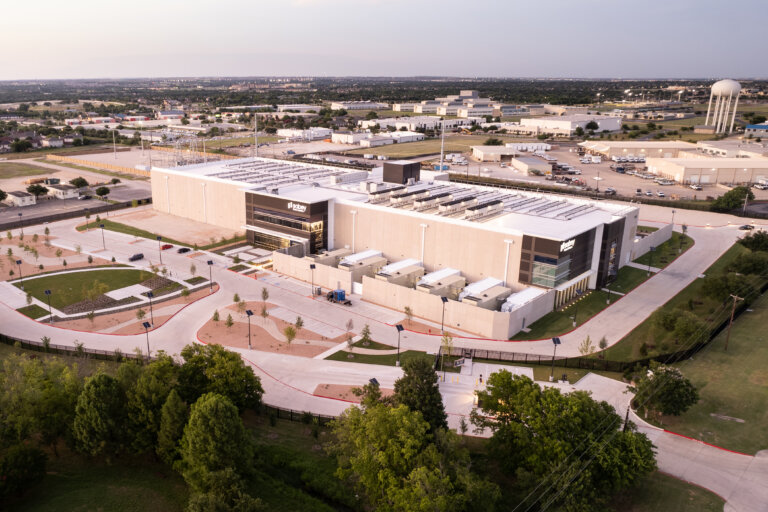
Switch announced its Round Rock campus in June 2021 after purchasing land from Dell Technologies and received approval to develop more than 1.5 million square feet of Tier-5 data center space; the City rezoned 36.76 acres for the initial phase in 2021 and an additional 32.48 acres in 2023 for expansion.
The PUD for the Amazon facility near CR 172 and SH 45 allows for a data center in the future, although no plans to construct one have been submitted to the City at this time.
Council also approved in 2024 a separate 57-acre development near Chisholm Parkway and I-35 that includes a data center, although that project has not begun.
Do data centers produce harmful containments in their wastewater?
We have not come across this issue with our two existing data centers. We monitor wastewater releases from industrial users and can require a user to pre-treat their flows if they are producing containments as some industrial users do. After reviewing the process and expected releases from our existing data centers, they were not required to pretreat as their flows are primarily from cooling and not the production or usage of containments. If anything were to change with these existing facilities, or should the Skybox facility move forward and produce concerning containments, the City would require pretreatment.
Is this site appropriate for a data center? What about noise?
This corridor had previously been designated for light industrial use, and a few sites have already been developed as such. The subject site is currently zoned for light industrial uses and is in between two existing light industrial uses. These existing light industrial uses, Chasco Constructors and Casa Mechanical, have existed on these sites for decades. Additionally, an auto collision center is present across Old Settlers Boulevard from this site.
Traditional light industrial uses typically include manufacturing, assembly, outdoor storage of materials, and shipping and receiving with loading docks. These uses result in more activity and more noise than what we have experienced with our existing data centers. Skybox, if the PUD is approved, will be required to be developed under modern development standards, and exceed standard code requirements for compatibility and landscaping adjacent to the single-family homes to the south. Noise will be required to comply with the City’s Noise Ordinance in the same manner that Chasco Constructors and Casa Mechanical does.
Do data centers cause air pollution?
Data centers do utilize back-up generators that typically run on fossil fuels. Data centers consume large amounts of electricity, and any potential environmental impacts would occur at the electric generation sites that supply that power. None of those facilities are located in Round Rock. However, the same is true for other industrial users and manufacturers that could be built on the site today without a rezoning from the City Council.
Did the City provide notice to the public about this rezoning?
Yes. City policy requires that we exceed the minimum State requirements for public notices for a rezoning. Mailed public notice was provided to all property owners within 325 feet of the subject site for both the Planning & Zoning Commission Public hearing and the City Council public hearing. Public notice signs were also placed on the property to alert passing motorists and pedestrians. An email was sent to the HOA representatives for the adjacent neighborhood, Chandler Creek, and nearby Homestead. The City’s website also advertised the public hearings and notices were placed in the Round Rock Leader.
What happens if the City Council denies this rezoning?
If the City Council votes to deny this rezoning, then Skybox cannot build a data center on this site. The site will remain zoned for light industrial uses and permits can still be pulled to construct manufacturing, warehousing, and other light industrial buildings in typical tilt-wall construction without City Council approval. Since there is a strong market demand for data centers in our area, Skybox will likely seek an alternative site nearby. This could include a site in our ETJ close to our city limits where we cannot regulate land use, or a nearby City. In either case, the electric and water consumption remains the same. Further, Round Rock will have no ability to impose development standards, permitting, building code inspections, or collect property or electricity bill sales taxes.