
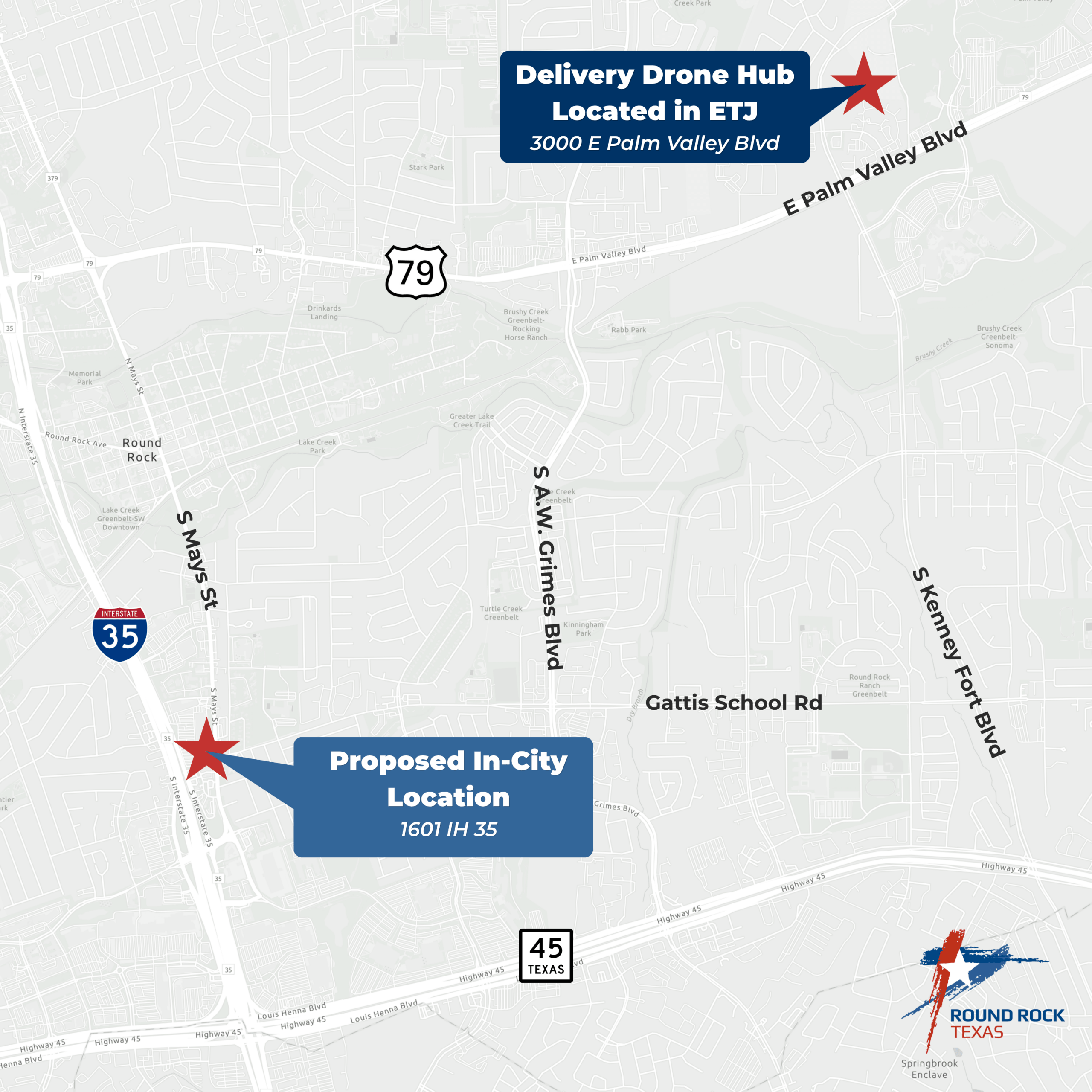
Drone delivery services are beginning operations in the Round Rock area. Zipline, a private drone delivery company, will operate from a facility at 3000 E. Palm Valley Blvd., located within Round Rock’s Extraterritorial Jurisdiction (ETJ).
Drone delivery operations are primarily regulated by the Federal Aviation Administration (FAA), rather than local governments. While the City of Round Rock does have limited authority over where drone facilities may be located within city limits, it does not regulate drone flight paths or oversee commercial delivery operations.
As this technology becomes more common in our community, the City is providing the following information to help residents understand how drone delivery works, who regulates it and where to direct questions or concerns.
Who regulates delivery drones?
Delivery drone operations are primarily regulated by the Federal Aviation Administration (FAA). Companies must obtain FAA certification (typically under Part 135) and comply with federal safety, airspace, and operational requirements before beginning service.
Local governments, including the City of Round Rock, may regulate land use and zoning, such as where drone infrastructure can be located within city limits, but FAA regulations and state law preempt the City’s ability to regulate the flight paths or prohibit the presence of drones in the city.
Where will drones operate?
Zipline is beginning commercial drone deliveries from a facility at 3000 E. Palm Valley Blvd., located in Round Rock’s Extraterritorial Jurisdiction (ETJ). According to the company, service will be available to eligible customers within three miles of this location and may expand to additional areas in the future.
Drone delivery hubs, where drones are stored, launched and recharged, are not specifically addressed under the City’s current zoning ordinances. The City is working with Zipline to allow a proposed in-City hub at the rear of Renaissance Square shopping center along northbound I-35. This location will provide an opportunity to evaluate drone delivery operations and their impacts, helping the City develop appropriate regulations for future facilities within city limits.
The FAA regulates drone flight operations, including airspace and flight paths. The City does not determine where drones may fly.
Are delivery drones safe?
Delivery drones must meet federal safety standards. Zipline provides a safety fact sheet on their website here: Zipline Safety Fact Sheet
Drone operators must comply with Federal Aviation Administration (FAA) requirements, which include:
- Certification of the operator (typically under Part 135 for delivery services)
- Aircraft design, maintenance and inspection standards
- Operational limitations related to airspace, altitude and weather
- Safety procedures for flights over people and property
To reduce risk, delivery drones are equipped with multiple safety features, which may include:
- Redundant systems (backup motors, batteries or navigation components)
- Real-time monitoring by trained operators
- Automated flight controls and geofencing
- Sensors to detect and avoid obstacles
The FAA evaluates and approves delivery operations based on their ability to manage potential risks such as equipment malfunction, loss of communication or unexpected weather changes.
Will drones fly over homes and neighborhoods?
Drones may fly over residential areas as part of approved flight paths. The City cannot regulate drone flight paths.
What about noise?
Delivery drones produce noise similar to a small electric device or lawn equipment at a distance. The City is allowed to regulate the location of delivery hubs inside city limits to ensure they are not adjacent to residential properties to mitigate any potential issues.
Who should I contact with concerns or complaints?
Operational issues (noise or nuisance): Contact the drone operator directly (855-947-5163, response-team@flyzipline.com)
Company-specific concerns: Contact the drone operator directly (855-947-5163, response-team@flyzipline.com)
Safety concerns or suspected FAA violations: Contact the FAA
What privacy protections are in place?
State law (Texas Government Code Chapter 423) currently restricts the use of drones for surveillance and helps protect individuals and private property:
- Capturing images of individuals or private property with the intent to conduct surveillance is a Class C misdemeanor (Section 423.003).
- Possessing such images is also a Class C misdemeanor, while distributing them is a Class B misdemeanor (Section 423.004).
- Civil penalties may apply, including fines of up to $5,000 per incident for unlawful image capture and up to $10,000 for distribution (Section 423.006).