

Are you a new homeowner in Round Rock? Have an irrigation system for the first time? Confused by it all?
City water conservation staff can visit your home and walk you through important water features, including:
- Operating your irrigation system,
- Determining how much water your current watering schedule uses,
- Providing a recommended watering schedule,
- Making recommendations on whether any system upgrades are needed;
- Identifying minor landscape issues (type of soil, grass, native plants),
- Locating your water meter,
- Finding your main water shut-off,
- and potentially more!
IMPORTANT NOTES:
- Irrigation system must be operational.
- Staff will not make repairs.
- Appointments take about an hour.
- We’ll need access to your irrigation controller, water meter, and both front and back yards.
- You must be a direct City of Round Rock water customer to qualify. (Sorry, MUD customers are not eligible.)
Ever wonder “When should I water my ya rd?” or “How long do I run each zone?”
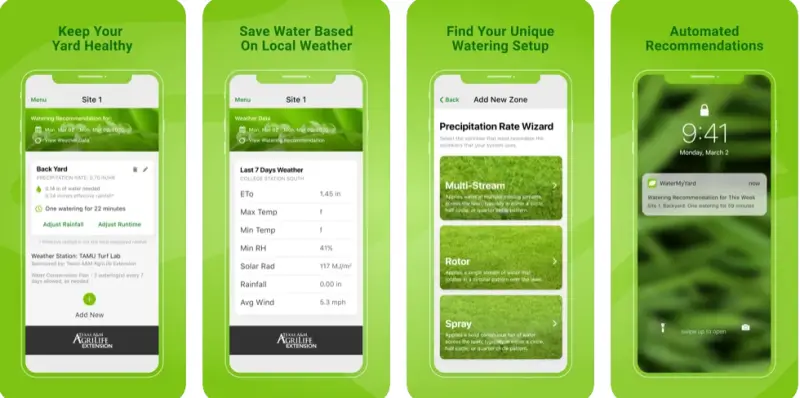
The City has partnered with the Lower Colorado River Authority (LCRA) and Texas A&M AgriLife Extension to help answer those questions! The Water My Yard program provides free weekly recommendations on how long to run each zone, based on your address, your irrigation system information, and local weather data.
To get started, visit WaterMyYard.org or download the app. You will need to answer questions about your irrigation system and landscape.
The START TIME is what time of day the program will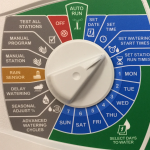 turn on to run.
We recommend using multiple start times, also called cycle and soak. Our clay soils cannot absorb water quickly and this breaks up a long runtime into smaller cycles. For example, running the whole program at 2:00 a.m. and then again at 4:00 a.m.
In our YouTube video, learn how to set up multiple start times on your controller.
Written instructions for setting multiple start times can be found here.
The RUN TIME is the length of time, in minutes, each station will run.
When scheduling a station (or zone) to water you need to consider the type of sprinkler head.
There are two main types of sprinkler heads—spray heads and rotor (or rotatory) heads. Both are usually located underground and pop-up when they water.
- Spray heads are stationary, they water the same piece of grass, or landscaping, the entire time they are popped up. Because they do not move, the runtime for these types of heads should stay at 15 minutes maximum, or less.
- Rotor heads move, or rotate when they pop-up and do not water the same place the entire time they are popped up. Because they move, they typically need to run for longer periods of time, generally 18 minutes minimum and longer.
- Rotor heads are the more efficient of the two head types, there’s less water lost to high pressure.
- Rotor heads are desirable to use in large areas—fewer heads are required to cover a large space since they spray water out a further distance than spray heads.
If using multiple start times, explained above in the start times section, the minutes for each station will be short, accounting for the fact that it will be running through the program twice. See this page for more specific recommendations – sunny or shady areas, grass or shrubs, and spray or rotor zones: Residential Irrigation Schedules.
Written instructions for setting the runtimes can be found here.
Irrigation use should be adjusted seasonally. Don’t just set it and forget it. This is one major reason why irrigation systems can be wasteful. Irrigation is also meant to supplement rainfall, so pay attention to rainfall amounts and turn the system off when rain is expected and keep off after rain events of greater than 1/2-inch.
Another thing to keep in mind is that Round Rock has Year – Round Water Use Restrictions. No irrigation is allowed between 10am and 7pm at any time of year unless a variance has been applied for, or you’re irrigating by hand.
Winter: This can be anytime from November through March or April.
- Keep the system off and water manually or hand-water if it’s needed.
- November through March is when the City determines your wastewater average. Keeping the system off all winter keeps your wastewater changes down the rest of the year.
- Winter is not the growing season for most plants and grasses. Landscapes are dormant. Generally only new or young trees may need extra water.
Spring: This could be March, April, May, or June. It really is very dependent on the weather. Is it cool? Hot? Rainy? Dry? The weather will determine when it may be time to irrigate. If rain is occurring, keep the system off.
- When you choose to turn your irrigation system on in the spring, it should be dry and temperatures consistently above 80 degrees during the day.
- Once per week watering, or less (such as once every 2 weeks), is plenty. Deeply water the yard on that one day and then turn it back off. Deep watering is more effective for the plant than multiple days of shallow watering.
Summer: this is the hottest time of year. It could be June or July, August, September, or October. Here in Central Texas, August and September are our hottest months of the year. Again, pay attention to rain events and turn off the irrigation system before and after events of greater than 1/2-inch rainfall.
- When choosing to start a regular schedule, start low! This means once per week, or less. See how the lawn responds.
- If overall the landscape looks good, keep it on the schedule and only increase the runtime (minutes) on the zones that look stressed out.
- Summer dormancy is normal with Bermuda grass, so do not be alarmed about grass dying. This is it’s natural reaction to dry conditions. It will perk back up in fall, when temperatures start to decrease.
- If the whole yard looks stressed out, even with irrigation there may be a soil issue, such as compaction. Make sure your lawn can accept the water you’re giving it. See our Landscaping page for more information about healthy soils.
- Shady yards may be fine with a good deep watering once every 7-14 days all summer long.
- Year – Round Water Standards are in effect year round! This means no more than twice per week irrigation, if needed. Find your water days here.
Fall: this is when temperatures start to cool. It could be October or November.
- When temperatures began to cool, for instance lower 90s or high 80s on a daily basis, reduce your use. Cut back by half. This means reducing down to one day per week if watering two days per week.
- It could mean going from one day down to once every other week with a shady yard.
- Wastewater averaging (mentioned above) starts with your November billing cycle. By Thanksgiving, you want to have that irrigation system turned off any regular program, to keep use low.
Do you have a leak in your irrigation system, or think you do?
First, physically look at your water meter to see what it is showing. This will help determine if water is flowing all the time or only when the system is running. Where’s your water meter? Learn here.
In the picture here, the meter face has a continuous flow indicator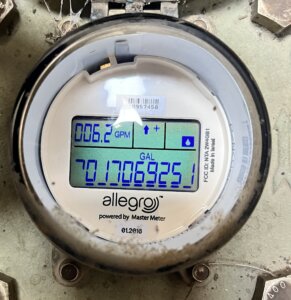 – the little water drop in the upper right corner of the meter face. This means that water has been flowing through the meter for 24-hours or longer, without stopping.
- If there is continuous flow, turn off water to the irrigation system at your backflow prevention device or main irrigation valve. See our YouTube video for how to do this.
- Once the backflow is turned off, look at the water meter again. If the flow has stopped, then the leak is in the irrigation system. (If the meter is still showing flow, the leak is on the mainline going to your house. The leak could be underground on the mainline or inside the home.)
- Time to call a Licensed Irrigator to locate the leak and repair it! You may be eligible for our Smart Irrigation rebate once the repairs are made.
- Sign up for automated water leak notifications from our customer water portal. These notifications are by text and email and multiple phone numbers and email address can be registered. The notification will be sent after 24-hours of continuous water flow registers on the water meter.
- Drip or soaker hoses or individual spray emitters are ideal for keeping water close to the roots, rather than spraying into the air and on the leaves.
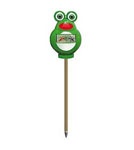
moisture meter - A soil moisture meter or long screwdriver can be used to determine how dry soil is in flowerpots, garden beds. Push the tool into the ground (if you can!) and feel how wet the soil is. Ideally you should be able to push it 6-inches deep.
- A hose timer can be used on your garden hose to set how long you want it to run. When the time ends, the hose timer stops water from coming out of the hose, however, you’ll still need to turn the water off at the spigot.
- A rain gauge is ideal to see how much rain your property receives during a rain event. If you’ve received 1/2-inch or more, no need to water for the week.
Battery Replacement
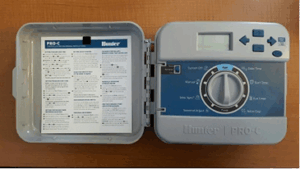
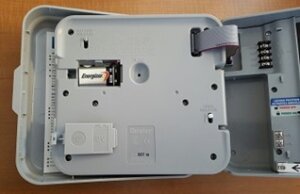
Many irrigation controllers have a location to install a back-up battery. A back-up battery will not operate your controller, however, it will save your program settings in case of a power outage. If your controller loses power and you have no battery, or a dead battery, some controllers will reset to factory default program settings. Default settings vary by brand and model.
Shown here is the battery location on a Hunter brand controller. A 9-volt battery fits behind the control panel.
Testing the Rain Sensor
By State Law, all irrigation systems installed since 2009 should have a working rain sensor on them. Do you know if yours is still working? Test it!
- Ensure that your controller sensor is set to Active. There is a switch on the controller face that may say Sensor Active and Sensor Bypass. Set to Active.
- Spray or pour water on the top circular open area where rain would fall into.
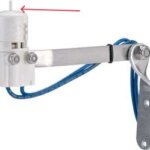
- Look at the controller screen. If it registers that the sensor is wet it will show “Rain Off” or “Sensor” or a picture of a little umbrella on the screen, depending on the controller brand. This means that the controller wouldn’t allow irrigation to occur, as it’s just rained.
- If the controller doesn’t show anything but the time and allows you to turn it on manually, its a safe bet that the sensor is no longer operational. Time to get a new one!
BONUS: Check out our Smart Irrigation rebate after purchasing your new sensor.
We generally do not recommend that you officially winterize irrigation systems, simply because we do not have extended freezes. Our freezes are short, overnight in most cases, and temperatures rise above freezing when the sun is out.
We do recommend turning off the master valve or the backflow prevention device to the irrigation system, to prevent water from flowing through the system. You can see how to do this in our video here.
That said, if you’re more comfortable fully protecting your system, that is great. The Texas A&M’s School of Irrigation has a host of videos and information about how to have your system winterized.
NOTE: PVB (pressure vacuum breaker) backflow devices are talked about in the videos–that can be ignored. We DO NOT have those type of backflow devices here in Round Rock. The typical backflow device is a DCA (double check assembly).